For years, much of the conversation around multicultural marketing has centered on representation, inclusion and the importance of reflecting America's increasingly diverse population.
These remain important objectives. But when multicultural marketing is primarily framed around representation, it can obscure a more fundamental business opportunity.
What if understanding culturally diverse consumers could help brands identify untapped demand, increase category participation, develop better products and discover entirely new avenues for growth?
This was one of the most compelling themes emerging from the 2025 Asian American Advertising Federation (3AF) Asian Marketing Summit in Los Angeles. Across presentations from global consumer brands, regional financial institutions and sports organizations, a consistent message emerged: cultural intelligence is not simply a communications capability. It is a business asset.
Growth Begins with Asking a Different Question
When developing a multicultural marketing strategy, brands often begin by asking:
How can we make our brand more relevant to this audience?
It is a reasonable question, but it assumes that the product, value proposition and underlying business strategy are already appropriate.
A more productive starting point might be:
What growth opportunities are we overlooking because we do not fully understand this audience?
The distinction is significant. The first question typically leads to decisions about messaging, creative execution and media placement. The second opens the door to category expansion, product innovation, customer acquisition and market development.
P&G's presentation at the summit illustrated why this distinction matters.
Lela Coffey, P&G's Vice President of Multicultural Business Acceleration, discussed how Asian American consumers participate in certain household and personal-care categories at different rates from other consumers.
For P&G, the opportunity is therefore not simply to win market share from competitors. It is also to grow the categories themselves.
Understanding what prevents consumers from adopting a product or using it more frequently can reveal opportunities that conventional market-share analysis might overlook.
The Business Opportunity Hidden Beneath Consumer Behavior
One particularly instructive example from P&G involved dishwasher detergent.
The company initially hypothesized that relatively low usage among Asian American consumers might be related to housing conditions, such as living in smaller apartments without dishwashers.
It was a plausible explanation. But deeper, in-home consumer research revealed something more nuanced.
For some consumers, washing dishes by hand was associated with the effort involved in caring for one's family. The behavior carried emotional and cultural meaning beyond the functional task of cleaning dishes.
This changes the nature of the marketing challenge.
If the issue is appliance ownership, the opportunity may be limited by infrastructure. If the issue is how consumers perceive cleanliness, care and responsibility, the opportunity may involve education, repositioning or demonstrating product benefits in a different way.
The example illustrates a broader principle: the same observed consumer behavior can have very different underlying motivations, and those motivations can determine whether a business opportunity is identified or missed.
Cultural intelligence helps brands move beyond observing what consumers do to understanding why they do it.
That understanding can also have implications for product innovation.
P&G discussed how Asian American consumers can bring demanding expectations to household and personal-care products, seeking both strong performance and gentleness, effectiveness and safety.
Meeting these expectations may create products that appeal to consumers far beyond the original target audience.
A culturally specific insight can become the starting point for broader market innovation.
Growing Beyond the Original Customer Base
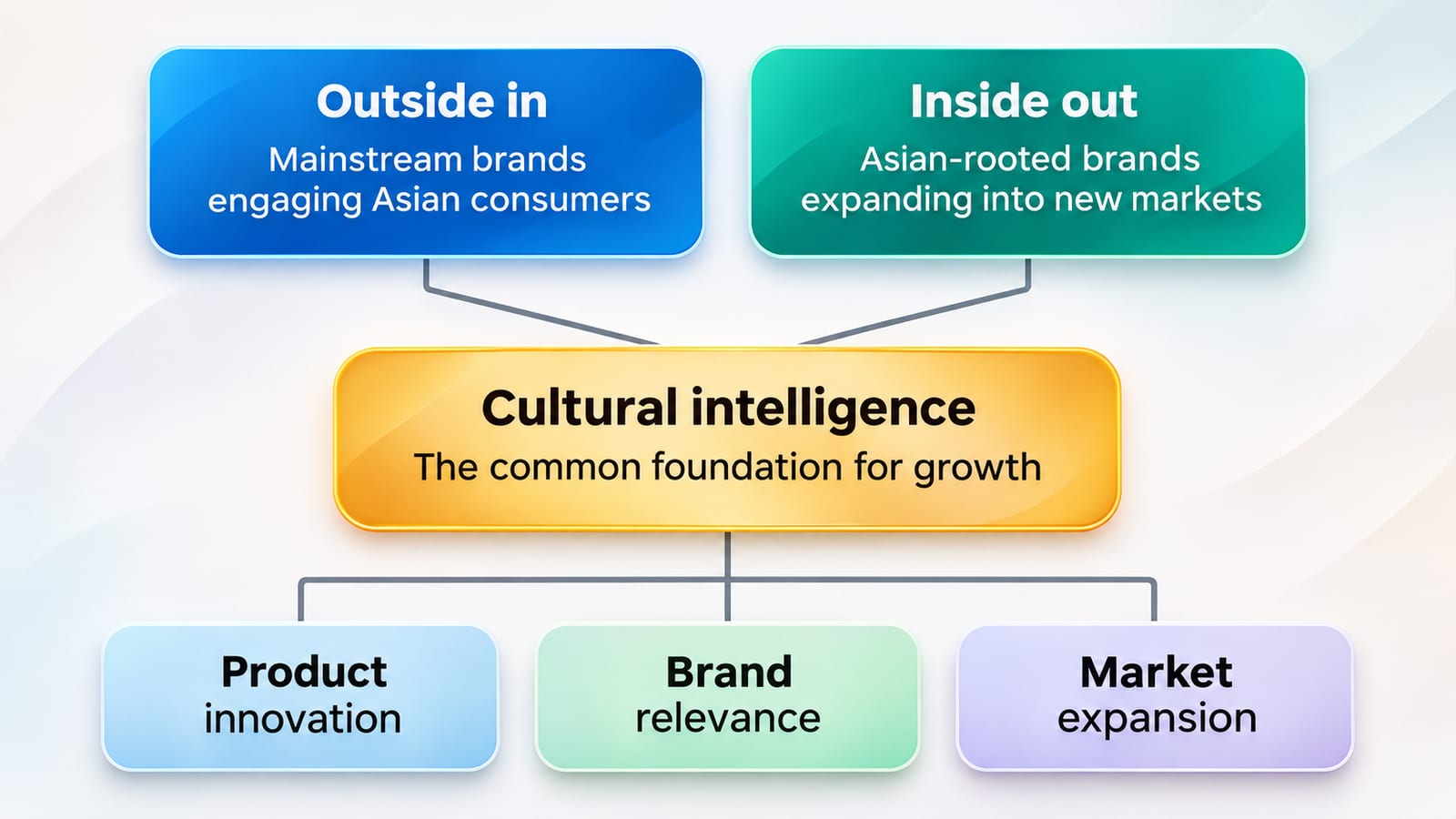
The relationship between culture and growth works in both directions.
While mainstream brands can identify new opportunities within culturally diverse communities, businesses rooted in those communities can also leverage their cultural understanding to expand into broader markets.
Commonwealth Business Bank, or CBB Bank, presented an example at the summit.
Originally established to serve the Korean American business community, the bank recognized that its existing customer base represented only a fraction of the potential market across its branch footprint.
Rather than simply expanding its advertising to additional ethnic groups, the bank examined what small-business owners across different cultural backgrounds valued in a financial partner.
The research identified shared needs: personalized service, responsiveness, an understanding of individual business circumstances and financial solutions that support customers' aspirations.
These were qualities that the bank had developed through its relationships with its original customer base.
Its CBB&ME campaign translated those strengths into customer-centered storytelling, demonstrating how the bank helps business owners pursue their goals.
The opportunity was not to become less culturally distinctive. It was to identify which of its established strengths could create value for a broader audience.
For businesses seeking to expand beyond their original markets, this is an important distinction. Cultural roots do not necessarily constrain growth. They can provide the foundation for it.
When Cultural Insight Becomes Mainstream Innovation
The rise of Asian food brands provides another illustration of this dynamic.
At the summit, bibigo discussed how its understanding of American consumers led to the development of microwavable steamed dumplings.
Traditional dumpling preparation did not necessarily fit the routines of consumers seeking convenience, minimal preparation and fewer dishes to clean.
By adapting the product format, bibigo made Korean food more accessible to a broader market without abandoning its culinary identity.
According to the presentation, the innovation subsequently found relevance in Korea as well.
This represents an interesting form of reverse innovation: insights from an international market can generate new opportunities in a brand's home market.
It also demonstrates why multicultural growth should not be viewed exclusively through the lens of audience targeting.
Understanding how different cultures approach food, convenience, wellness, family life and consumption can reveal opportunities to rethink established product categories.
The value of cultural intelligence is not limited to the consumers from whom the insight originated.
The Risk of Treating Multicultural Marketing as a Separate Function
One of the challenges facing many organizations is that multicultural marketing remains organizationally disconnected from core business strategy.
It may be managed through a separate budget, assigned to a specialist team or introduced after major product and positioning decisions have already been made.
This structure can support culturally relevant communications, but it limits the ability of cultural insights to influence upstream business decisions.
By the time a creative brief reaches a multicultural marketing team, many of the most consequential decisions may already have been made:
- Which consumer needs the product is designed to address.
- Which audiences are prioritized.
- How the category is defined.
- What the brand promises.
- Which distribution channels are used.
- How success will be measured.
If cultural understanding enters the process only at the advertising stage, brands may be optimizing communications around assumptions that have never been adequately examined.
Integrating cultural intelligence earlier creates opportunities to challenge those assumptions before significant investments are committed.
From Representation Metrics to Business Outcomes
Recognizing culture as a growth engine also requires reconsidering how multicultural marketing success is measured.
Representation, reach and cultural relevance remain meaningful indicators. However, they should be connected to the business outcomes a brand is trying to achieve.
Depending on the opportunity, these may include:
| Growth objective | Strategic question |
|---|---|
| Category expansion | What prevents consumers from adopting or using our category more frequently? |
| Customer acquisition | Which underserved consumers could benefit from our existing offering? |
| Product innovation | What culturally influenced needs are not adequately addressed? |
| Market expansion | Which of our established strengths could appeal to new audiences? |
| Customer retention | How can we better serve consumers throughout their relationship with our brand? |
| Brand differentiation | What cultural insights or assets could create a distinctive competitive advantage? |
This approach does not diminish the importance of representation. Instead, it gives multicultural investment a stronger connection to the organization's broader commercial objectives.
It also makes cultural intelligence relevant to leaders beyond the marketing department, including product development, innovation, customer experience and business strategy.
Five Questions Brand Leaders Should Be Asking
As brands evaluate their next sources of growth, five questions are worth incorporating into strategic planning:
- Where are we seeing differences in category participation across cultural groups, and do we understand why?
- Are we interpreting consumer behavior through assumptions that reflect only the dominant cultural perspective?
- Could unmet needs within a particular community reveal a broader product or service opportunity?
- Which aspects of our brand's cultural identity or expertise could create value for consumers beyond our existing customer base?
- Are cultural insights informing our business decisions early enough to make a meaningful difference?
These questions move the conversation beyond whether brands should invest in multicultural marketing to how cultural understanding can help them make better business decisions.
Culture as a Competitive Advantage
As markets mature and competition intensifies, growth increasingly depends on identifying opportunities that others have overlooked.
Consumers whose needs, motivations and behaviors are poorly understood may represent precisely those opportunities.
Yet the greatest value of multicultural research is not necessarily the identification of another audience to target. It is the ability to see existing markets differently, challenge established assumptions and uncover new possibilities.
Representation helps consumers see themselves in a brand.
Cultural relevance helps consumers recognize that a brand understands them.
Cultural intelligence helps brands discover what they have been missing.
Culture is not simply something brands need to accommodate. It is something they can learn from—and grow through.
This article is part of Sparkle Insights' conference intelligence series, drawing on presentations and discussions from the 2025 3AF Asian Marketing Summit in Los Angeles. Featured conference perspectives: Procter & Gamble, CBB Bank and bibigo.