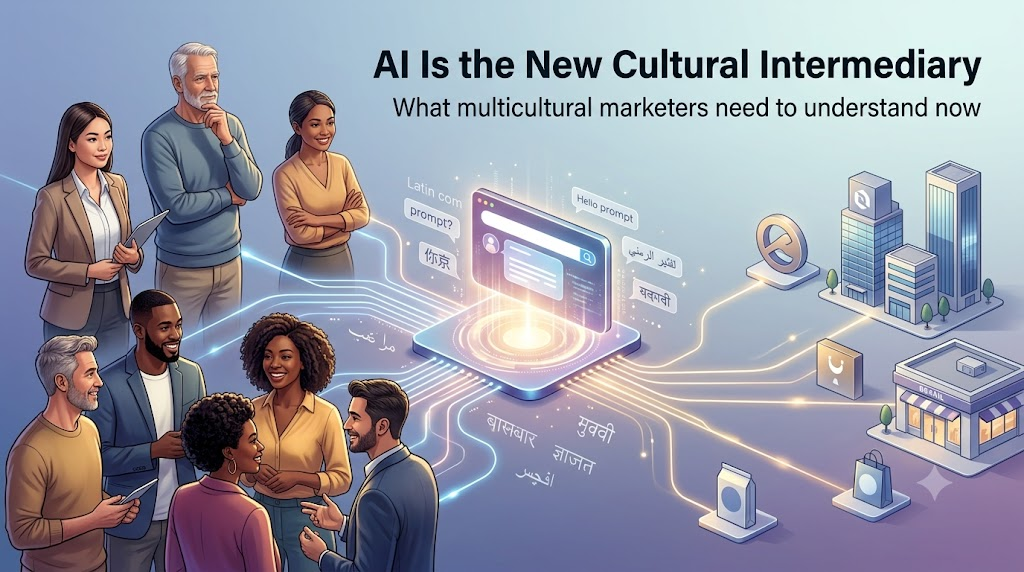
Artificial intelligence has made it remarkably easy to produce marketing content for almost any audience.
Give an AI system a country, a demographic profile, a cultural background, and a product category, and it can generate advertising concepts, consumer personas, campaign messages, and visual imagery in seconds.
The results often look convincing. The language may be fluent. The imagery may include recognizable cultural symbols. The messaging may even sound culturally appropriate.
But looking culturally relevant is not the same as being culturally meaningful.
This distinction emerged as one of the most important themes at DigiAsia 2026, held in Taipei under the banner Heartificial Intelligent Marketing.
While much of the conference explored how AI is transforming advertising, media, and creative production, several speakers raised a deeper question: Can AI truly understand the cultural contexts that shape how people think, feel, and make decisions?
Their presentations revealed a tension that marketers can no longer afford to overlook.
AI is making the production of culturally customized content faster and cheaper. Yet its ability to generate convincing representations can also obscure shallow assumptions, missing perspectives, and cultural misunderstandings.
The challenge is not simply getting AI to produce content that looks local. It is ensuring that the ideas behind that content reflect the people they are intended to reach.
180 Million People Don't Fit in One Prompt
One of the conference's most memorable presentations came from Muhammad Nafeezul Bari of Adcomm Limited in Bangladesh.
His session, titled Why 180 Million People Don't Fit in One Prompt, challenged the assumption that a large and culturally complex population can be adequately represented through a handful of demographic descriptors.
Bari used an AI-generated hair-care advertising example to illustrate how creative content can appear plausible while overlooking important cultural meanings.
The broader issue extends well beyond Bangladesh.
Consider what happens when marketers ask AI to create a campaign targeting "Asian consumers," "Hispanic families," or "young women in Southeast Asia."
These categories may be useful starting points for market definition, but they are not complete descriptions of consumers.
Within any population are differences in language, upbringing, socioeconomic circumstances, geography, generational experience, identity, and personal values.
Even people who share an ethnic background may interpret the same message differently.
An AI model may generate a convincing approximation of what advertising for a particular culture should look like. But unless it has access to relevant, reliable evidence, the result may reflect patterns in its training data rather than the lived realities of the intended audience.
This creates a particular danger: AI can make an incomplete understanding of consumers look polished and authoritative.
For marketers, the implication is significant.
The problem is no longer simply whether we can create culturally relevant-looking content. It is whether we have enough knowledge to recognize when that content misses the mark.
Cultural Representation Is More Than Language and Symbols
A related perspective came from Professor Jerry Liu of the National Taiwan University of Arts.
His presentation explored the relationship between cultural technology, emotional warmth, and Taiwanese identity.
Liu questioned the generic visual representations and cultural categories that AI systems may use when depicting Taiwan.
The concern was not merely whether technology could reproduce recognizable Taiwanese imagery. It was whether those representations could convey the deeper meanings of culture, identity, and collective experience.
This distinction matters because cultural authenticity is not achieved simply by adding traditional clothing, recognizable landmarks, food, or local language to a creative execution.
Culture also encompasses how people understand relationships, express emotions, interpret symbols, navigate social expectations, and make sense of their experiences.
The same image, expression, or storyline can carry different meanings depending on its context.
Liu's perspective also broadened the conversation about AI sovereignty.
Discussions of technological sovereignty often focus on computing infrastructure, language models, and control over data.
But cultural sovereignty raises another question: Who gets to define how a community is represented by technology?
When AI-generated content becomes increasingly common, the images, narratives, and assumptions embedded in these systems can influence how communities are understood by others—and potentially how they see themselves.
This is why local expertise and community participation are important not only during creative development, but also in evaluating the cultural assumptions built into AI applications.
For brands, the lesson is straightforward: cultural authenticity cannot be reduced to accurate translation or recognizable imagery.
It requires understanding the meanings those elements carry for the audience.
Why Local Knowledge Matters in AI Development
Another dimension of cultural intelligence emerged from Hon Hai Research Institute's presentation on FoxBrain, an AI initiative developed with attention to manufacturing applications and Traditional Chinese contexts.
Dr. Yung-Hui Li discussed the practical limitations of relying solely on general-purpose AI models for specialized knowledge.
Manufacturing expertise exists across technical documents, maintenance records, operating procedures, and the experience of skilled workers. A model with broad general knowledge may still lack the specific information needed to support a particular industrial environment.
FoxBrain illustrated the importance of connecting AI systems with relevant knowledge, local-language information, and domain-specific expertise.
Although this example came from manufacturing rather than advertising, its implications for marketing are substantial.
A general-purpose AI system may know a great deal about a market in broad terms. But does it understand how consumers in a particular community use a product? What concerns influence their choices? Which expressions feel natural? What cultural tensions shape their expectations?
These are not questions that can always be answered through general training data.
They often require proprietary research, local market experience, qualitative exploration, and ongoing engagement with consumers.
The same principle applies to language.
Language is not simply a vehicle for translating an idea. It carries cultural associations, emotional nuances, and contextual meanings that may not transfer directly between markets.
This is especially important across Asia, where linguistic and cultural diversity can make regional generalizations misleading.
AI can become more useful when it is connected to relevant local knowledge. But its ability to process that information should not be confused with an ability to independently validate whether the underlying evidence is accurate, representative, or current.
A better model does not automatically compensate for weak audience understanding.
Reaching Cultural Audiences Requires More Than Broad Demographics
While the presentations from Bangladesh and Taiwan emphasized cultural meaning and representation, Jay Kim of AAAZA addressed a different but related challenge: reaching specific cultural audiences through media.
His presentation explored the use of geofencing and lifestyle-based targeting to identify potential Asian American audiences.
For marketers, this raises an important distinction between reaching a community and understanding it.
Geographic and behavioral signals may help identify locations or environments associated with particular populations.
For example, Asian supermarkets, restaurants, cultural institutions, and community gathering places may offer contextual opportunities for media placement.
But visiting an Asian supermarket does not establish someone's ethnicity. And sharing a broad Asian American identity does not mean consumers have interchangeable cultural backgrounds or media habits.
Chinese, Indian, Filipino, Korean, Vietnamese, and other Asian American communities may differ considerably in language preferences, cultural traditions, media consumption, and product-category behavior.
There are also important differences within these communities, including those associated with age, nativity, acculturation, and personal experience.
AI can help marketers analyze available information and develop more sophisticated media-planning approaches. But targeting precision and cultural understanding remain separate questions.
A campaign can successfully reach a culturally specific audience and still deliver a message that fails to resonate.
Conversely, a culturally insightful message may underperform if it does not reach the people for whom it was developed.
Effective cross-cultural marketing therefore requires both: a credible understanding of the audience and an appropriate strategy for reaching them.
Geographic and behavioral data can support this work, but they should be treated as imperfect indicators rather than definitive evidence of identity.
The Risk of Cultural Homogenization
Taken together, these presentations point toward a broader risk in AI-powered marketing: cultural homogenization.
As marketers increasingly rely on similar AI models, tools, and prompt structures, campaigns may become more alike.
Eric Chang of McCann Taiwan raised a related concern about AI-driven creative production, warning of what he characterized as brain dilution: the tendency toward similar-looking, emotionally shallow, or visibly artificial output.
AI can generate a remarkable volume of content. But when different organizations draw on the same generalized patterns, scale may come at the expense of originality and specificity.
In cross-cultural marketing, this risk is particularly pronounced.
A model may repeatedly associate certain colors, symbols, family structures, celebrations, or emotional themes with a particular cultural group.
Those associations can become shortcuts for creative development, even when they represent only a narrow portion of a community's experiences.
The result may be content that is recognizable but predictable, culturally familiar but emotionally unconvincing.
This is not an argument against using AI for multicultural marketing.
AI can help explore alternative creative directions, adapt content across languages, synthesize research, and accelerate production.
The problem arises when generated content becomes a substitute for understanding the audience.
Instead of asking whether AI can make a campaign look more culturally appropriate, marketers should ask whether the underlying strategy reflects something meaningful about consumers' lives.
From Cultural Customization to Cultural Intelligence
The DigiAsia discussions suggest that marketers need to distinguish between two very different capabilities.
Cultural customization adapts the surface characteristics of communication.
It might involve changing language, imagery, casting, examples, or cultural references.
Cultural intelligence examines the underlying motivations, values, contexts, and experiences that influence how people interpret communication and make decisions.
Both can contribute to effective marketing. But customization without intelligence can easily become superficial.
Consider the difference between translating a financial-services advertisement into another language and understanding how different communities approach financial security, family obligations, trust in institutions, or long-term planning.
Or between including culturally recognizable foods in a campaign and understanding the emotional significance of food within family relationships and daily routines.
The first task can often be accelerated through technology.
The second requires evidence, interpretation, and cultural sensitivity.
In practice, AI may be particularly useful when it helps marketers engage more deeply with existing research and explore questions that would otherwise be overlooked.
It can help organize consumer interviews, identify recurring themes, compare audience segments, and surface hypotheses for further investigation.
But these capabilities depend on the quality, relevance, and representativeness of the underlying information.
AI-generated interpretations should be evaluated as analytical outputs, not accepted as direct consumer testimony.
The strongest approach combines technological capabilities with research-grounded cultural intelligence.
What Marketers Should Do Differently
For organizations developing AI-enabled campaigns across culturally diverse audiences, the conference offers several practical lessons.
Start with consumer evidence, not cultural prompts
Before asking AI to create a campaign for a specific community, establish what is known about the audience through reliable research.
Identify the motivations, tensions, experiences, and decision-making contexts relevant to the category.
Where important knowledge is missing, recognize the gap rather than allowing AI to fill it with plausible assumptions.
Examine differences within cultural groups
Avoid using broad ethnic or regional labels as substitutes for meaningful segmentation.
Consider which subgroup, language, generational, geographic, or life-stage differences materially affect the marketing decision.
Not every campaign requires extensive subgroup research. But the decision to combine audiences should be supported by evidence rather than convenience.
Involve people who understand the context
Local researchers, cultural strategists, community members, and consumers can help identify meanings that are not obvious from translated copy or visual references.
Their contribution should begin during strategy development rather than being limited to a final cultural-sensitivity check.
Use AI to generate hypotheses, not declare cultural truths
AI can be valuable for exploring alternative interpretations and potential creative directions.
However, an AI-generated consumer persona is not equivalent to a researched audience segment, and simulated consumer reactions should not be presented as actual research findings.
Use AI to sharpen questions and accelerate analysis. Validate consequential assumptions through appropriate consumer evidence.
Evaluate cultural resonance before scaling production
The ability to generate dozens of creative variations does not guarantee that any of them will connect with the intended audience.
Qualitative interviews, concept testing, and other research methods can help identify unintended interpretations, emotional disconnects, and opportunities for stronger relevance.
Where appropriate, assess whether creative executions resonate differently across meaningful audience subgroups.
Preserve cultural learning
As organizations accumulate research, campaign evaluations, and market experience, this knowledge becomes an increasingly valuable asset.
AI systems can help teams retrieve and reuse evidence, but only if that evidence is organized, properly attributed, and kept current.
Cultural understanding should be treated as an institutional capability that improves over time—not as a one-time input to a campaign prompt.
The Human Advantage in an AI-Native World
DigiAsia 2026 demonstrated how rapidly AI is changing marketing.
Organizations can now generate strategies, creative concepts, audience analyses, and content at a speed that would have been difficult to imagine only a few years ago.
But the presentations from Bangladesh, Taiwan, and the broader marketing industry revealed a critical limitation.
The ability to generate culturally recognizable content does not guarantee an understanding of cultural meaning.
AI can identify patterns, translate language, and reproduce familiar representations. It can also help marketers organize evidence and explore possibilities.
What it cannot reliably do on its own is determine whether the information it has learned reflects the lived experiences, changing expectations, and distinctive realities of the people a brand wants to reach.
That requires research, curiosity, cultural expertise, and human judgment.
As AI-generated marketing becomes more abundant, these capabilities may become an increasingly important source of differentiation.
The competitive advantage will not necessarily belong to the organizations that generate the greatest volume of culturally customized content.
It will belong to those that understand their audiences deeply enough to create something genuinely meaningful.
Technology can help marketers speak to more people, in more languages, across more channels.
Human insight helps ensure they have something worth saying.
This article is an independent Sparkle Insights analysis drawing on presentations at DigiAsia 2026, held October 28–29 in Taipei, Taiwan. It references contributions from Muhammad Nafeezul Bari (Adcomm Limited), Professor Jerry Liu (National Taiwan University of Arts), Dr. Yung-Hui Li (Hon Hai Research Institute), Jay Kim (AAAZA), and Eric Chang (McCann Taiwan). Interpretations and recommendations are those of Sparkle Insights.
Explore the broader findings in Sparkle Insights' DigiAsia 2026 conference report, The Human Advantage in an AI-Native Marketing World.