Artificial intelligence has already changed how marketers work.
A strategist can ask AI to analyze a market. A researcher can summarize interviews. A creative team can generate concepts. A media planner can develop recommendations in minutes rather than days.
These capabilities are impressive, but most remain centered on individual tasks.
What happens when AI moves beyond helping people perform isolated activities and begins connecting the activities themselves?
And what happens when these systems can draw on everything an organization has learned through years of consumer research, campaigns, creative development, and business decisions?
At DigiAsia 2026 in Taipei, several presentations pointed toward a significant shift in how marketing organizations may operate.
The next stage of AI transformation is not simply about providing employees with more powerful tools. It is about redesigning workflows so that AI, human expertise, and organizational knowledge work together as an integrated system.
This shift has important implications for brands, agencies, and research organizations.
It also raises a fundamental question: As AI capabilities become more widely available, what will make one organization's intelligence more valuable than another's?
From AI Assistants to AI-Enabled Organizations
Most marketers have experienced AI as an assistant.
We provide instructions, receive an output, review it, and decide what to do next.
This model is useful, but it leaves much of the coordination between activities to people.
A marketing team might use one AI tool to analyze research, another to develop strategy, and a third to produce creative concepts. Yet employees still need to transfer information between systems, reconcile conflicting outputs, and ensure the work remains aligned.
At DigiAsia 2026, Mahesh Neelakantan of Microsoft Asia discussed the evolution toward what Microsoft describes as Frontier Firms—organizations that integrate AI agents into broader business operations.
In this model, AI progresses beyond individual assistance toward interconnected systems in which specialized agents perform different functions while people retain responsibility for direction, judgment, and oversight.
For example, rather than asking an AI assistant to summarize a consumer research report, an organization might develop a coordinated workflow that retrieves relevant research, identifies audience needs, compares previous campaign performance, prepares strategic alternatives, and presents recommendations for human review.
The important innovation is not necessarily that any single task becomes dramatically more sophisticated.
It is that information can move more efficiently between tasks without requiring people to repeatedly reconstruct the context.
This is a change in organizational design, not just software capability.
AI Agents Are Changing the Division of Labor
The concept of an AI agent is sometimes presented as though it means replacing a person with an autonomous digital worker.
In practice, the more important question is how responsibilities are distributed between people and machines.
Different activities require different levels of judgment and accountability.
Retrieving an approved research report is relatively straightforward. Summarizing its findings involves interpretation. Recommending a marketing strategy introduces greater uncertainty. Automatically launching a campaign or changing a budget creates additional operational and financial risks.
These activities should not receive the same level of autonomy.
At DigiAsia, LINE Taiwan described the evolution of its business-account ecosystem toward AI-supported interactions and coordinated customer services.
This points toward a future in which conversational interfaces do more than answer questions. They may help customers complete tasks, access relevant services, and navigate connected business functions.
Dr. Willie Yang of eLAND Information Corporation described another application: connecting specialized datasets with general-purpose AI models so users can access business intelligence through conversational tools.
For marketers, such systems could make complex information easier to explore without requiring every user to understand the underlying database structure.
But the value of these applications depends on more than the sophistication of the AI model.
AI needs access to the right information, clear instructions about what it is authorized to do, and appropriate human oversight.
A system that can retrieve information but lacks context may produce misleading conclusions. An agent that can take actions without effective safeguards may create risks faster than an employee can identify them.
The future division of labor therefore requires deliberate choices about which activities should be automated, which should be AI-assisted, and which require human approval.
The Missing Ingredient: Organizational Memory
While AI agents can change how work gets done, another theme emerged repeatedly at DigiAsia: the value of what organizations already know.
Marketing organizations generate substantial knowledge through their everyday work.
Every research project produces insights about consumers. Every campaign generates performance data. Every creative development process involves decisions about what to pursue, revise, or reject. Every client engagement reveals something about a category, audience, or business challenge.
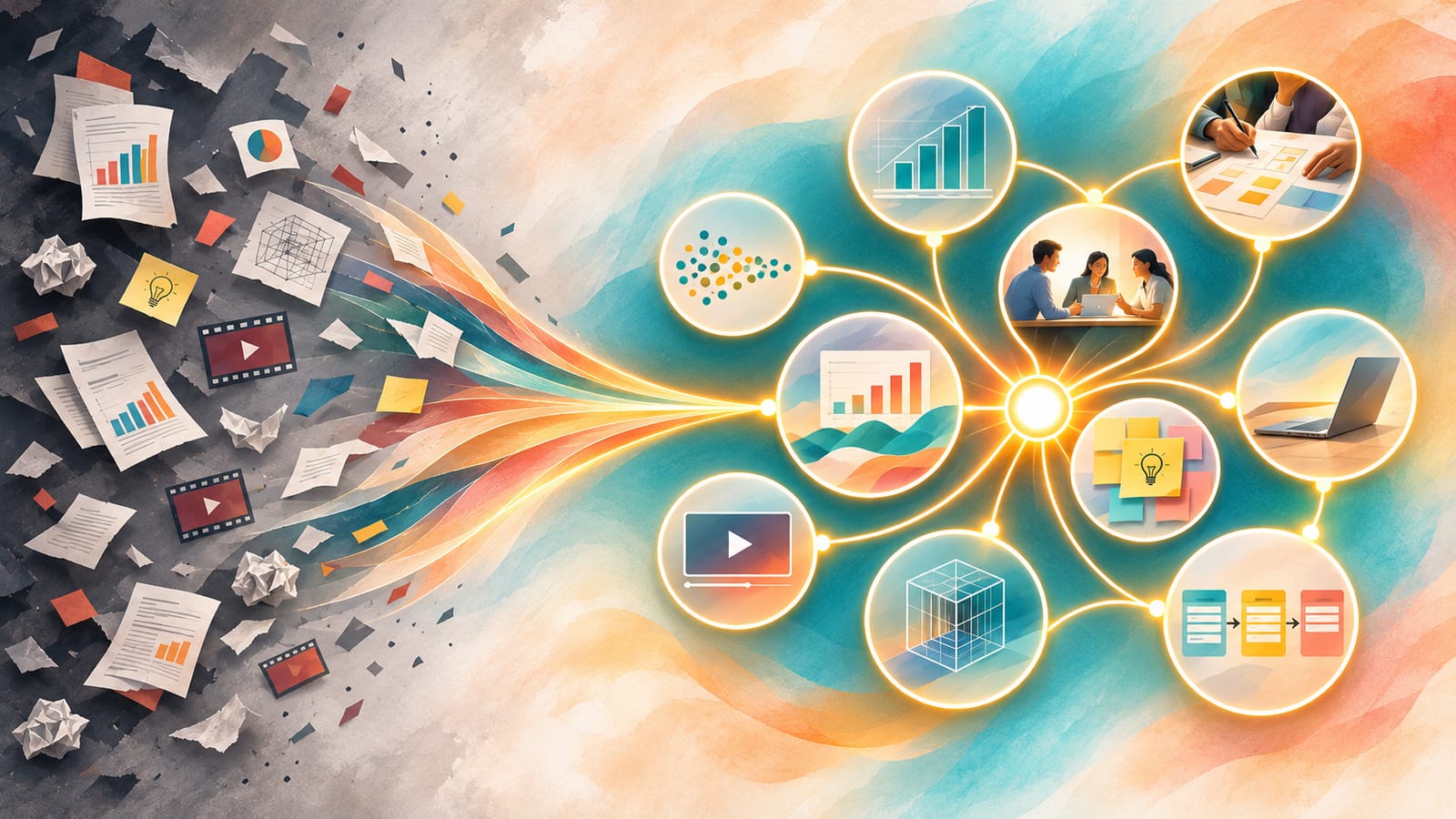
Yet much of this knowledge is difficult to retrieve after a project concludes.
Research findings remain in presentation decks. Campaign evaluations sit in isolated folders. Strategic decisions are buried in meeting notes. Experienced employees carry valuable knowledge that may never be documented.
When a new project begins, teams often repeat work that has already been done.
AI offers an opportunity to change that—but only if organizations treat accumulated knowledge as an asset worth organizing.
Taboola: Making Past Experiments Useful for Future Decisions
Joseph Yen of Taboola described the importance of continuous experimentation and learning in data-driven optimization.
One particularly relevant idea involved making previous engineering experiments—both successful and unsuccessful—accessible through an AI-supported knowledge repository.
Instead of treating unsuccessful experiments as information to be forgotten, the organization can preserve what was attempted, what happened, and what was learned.
This allows future teams to build on earlier work rather than repeat the same mistakes.
The principle is highly transferable to marketing.
Imagine a creative strategist preparing a campaign who can retrieve previous concept tests, identify which messages failed with particular audiences, understand why certain approaches were rejected, and examine how subsequent revisions performed.
That knowledge could improve the quality of initial recommendations and reduce unnecessary repetition.
The competitive advantage would not come from having a model capable of generating campaign ideas.
Many organizations have access to that capability.
It would come from having a reliable body of accumulated evidence that helps the organization generate better-informed ideas.
From Campaign Archives to Brand Intelligence
Chris Hsia of Adbert explored a related challenge from the agency perspective.
Marketing teams frequently create substantial amounts of information, but much of it loses practical value once a campaign ends.
Even when reports are saved, the underlying insights may not be organized in a form that supports future planning.
Adbert proposed a brand intelligence system capable of drawing on historical campaigns, consumer information, sentiment, and media results.
The broader vision is to move beyond treating each campaign as an isolated assignment and begin building a continuously developing understanding of the brand.
This could fundamentally change how agencies deliver value.
Traditionally, agencies have been compensated largely for activities associated with individual projects: strategy development, creative production, media planning, and execution.
But if AI makes many production tasks faster and less expensive, the ability to preserve and apply accumulated brand knowledge may become increasingly important.
An agency that understands a client's customers, historical campaigns, competitive environment, and strategic decisions can potentially offer more valuable guidance than one that simply produces the next deliverable quickly.
This is not simply a technology opportunity.
It requires disciplined documentation, appropriate data ownership arrangements, and a commitment to learning from outcomes.
The more consequential question becomes:
Does every campaign make the organization smarter, or does each new campaign begin almost from scratch?
McCann Taiwan: Giving AI Access to Accumulated Expertise
Eric Chang of McCann Taiwan demonstrated how the agency is exploring AI-assisted marketing strategy development through its Promkt.ai platform.
The system draws on structured planning processes and accumulated agency work to help generate elements such as situation analyses, consumer personas, communication concepts, and media recommendations.
The presentation illustrated how AI could dramatically compress the preparation of an initial marketing plan.
But Chang also stressed the importance of human intelligence in evaluating and refining AI-generated output.
He raised concerns about what he described as brain dilution: the tendency for AI-generated work to become repetitive, emotionally shallow, or insufficiently differentiated.
This highlights an important distinction.
Access to historical information can help an AI system produce more relevant recommendations. But historical knowledge alone does not guarantee strategic originality.
Past campaigns may contain outdated assumptions. Previous approaches may have worked in circumstances that no longer exist. Successful strategies can become formulas that constrain new thinking.
An effective organizational intelligence system therefore needs to do more than retrieve previous work.
It must help people understand the evidence, recognize its limitations, and determine whether it remains relevant.
Organizational memory should inform judgment, not replace it.
FoxBrain: Why Specialized Knowledge Matters
A related lesson came from Dr. Yung-Hui Li of Hon Hai Research Institute.
His presentation on FoxBrain explored the development of AI capabilities grounded in manufacturing knowledge, enterprise-specific requirements, and Traditional Chinese language contexts.
In manufacturing, relevant knowledge is distributed across technical documentation, maintenance records, equipment data, and specialist experience.
A general-purpose AI system may possess extensive broad knowledge while lacking the precise information needed to address a particular industrial problem.
FoxBrain illustrated the value of bringing specialized expertise and local context into AI systems.
For marketing and research organizations, the parallel is clear.
A general-purpose model may provide a reasonable overview of a consumer category. But it may lack access to proprietary audience research, historical campaign evaluations, cultural nuances, client-specific constraints, and lessons learned from previous projects.
These forms of knowledge can make a substantial difference to the quality of strategic recommendations.
Importantly, this does not mean every organization needs to develop its own foundation model.
For many companies, the more practical opportunity is to organize existing knowledge and connect it securely to established AI systems.
The goal is not technological independence for its own sake.
It is ensuring that AI-supported decisions reflect the organization's actual expertise and evidence.
When AI Agents Meet Organizational Memory
The most interesting opportunity emerges when these two trends converge.
AI agents can coordinate work across functions. Organizational memory can provide the context and evidence that make those activities useful.
Together, they could enable a very different marketing workflow.
Consider a hypothetical campaign-planning process.
A team receives a brief for a product targeting several culturally diverse consumer groups.
An AI-supported research function retrieves relevant studies, previous consumer interviews, and available market information.
A strategy function compares the findings with earlier campaign outcomes and identifies unanswered questions.
A creative development function uses the approved brief and research evidence to explore alternative messaging directions.
An evaluation function identifies potential weaknesses, unsupported claims, and cultural considerations that require further testing.
Finally, the team reviews the findings, challenges assumptions, and decides which directions deserve investment.
Each function has a defined responsibility. Each draws from approved information. Important decisions remain with the people accountable for the work.
This is an illustrative workflow, not a system presented as fully implemented by any single DigiAsia speaker.
Its value is to show how connected AI capabilities might support a more coherent, evidence-informed process.
It also shows why the quality of organizational knowledge becomes increasingly important as AI gains greater operational responsibility.
Without reliable information, a connected system may simply automate the circulation of weak assumptions.
Why Data Quality Matters More Than Ever
AI can make information easier to retrieve and synthesize. It cannot automatically determine whether the underlying information deserves to be trusted.
This is particularly important in market research.
A consumer interview provides a specific kind of evidence. A representative survey provides another. A social listening dataset offers a different perspective, with its own coverage limitations.
These sources should not be treated as interchangeable.
If an AI system combines them without preserving their origins, methods, dates, and limitations, its recommendations may appear more authoritative than the evidence supports.
For example, a finding from a small qualitative study should not be presented as a statistically representative conclusion about an entire population.
Similarly, an AI-generated consumer simulation should not be treated as equivalent to feedback collected from actual participants.
As organizations build AI-accessible knowledge systems, they need a disciplined approach to source attribution, research methodology, data quality, and uncertainty.
The system should distinguish between what consumers actually reported, what analysts concluded, what remains hypothetical, and what has been validated through subsequent testing.
This may be one of the most important contributions that professional researchers can make to AI transformation.
The challenge is no longer simply generating information quickly.
It is ensuring that the information entering automated workflows retains its meaning, context, and credibility.
A Practical Roadmap for Marketing Organizations
The DigiAsia presentations suggest that organizations do not need to begin with a comprehensive, fully autonomous AI platform.
A more practical approach is to build capabilities incrementally.
1. Identify where knowledge is being lost
Examine what happens to research findings, creative evaluations, media results, and strategic decisions after projects conclude.
Determine which information would be valuable to future teams but is currently difficult to retrieve.
2. Organize existing knowledge before automating it
Develop consistent methods for documenting projects, labeling evidence, identifying sources, and preserving decision histories.
Make sure the information is accurate, current, and appropriately permissioned.
3. Start with a clearly bounded workflow
Choose a repetitive process in which relevant information already exists.
Examples might include preparing an initial research synthesis, retrieving past campaign learnings, or assembling a first-pass strategic briefing.
Measure whether AI improves speed, quality, and usefulness relative to the existing process.
4. Define human responsibilities explicitly
Decide what AI can retrieve, generate, recommend, or execute.
Require human review when activities involve sensitive information, cultural representation, external communication, financial commitments, or consequential strategic decisions.
5. Capture new learning continuously
After each project, record the original problem, evidence considered, decisions made, outcomes observed, and important lessons.
Feed validated learnings back into the knowledge system.
Over time, the objective is to create a reinforcing cycle: accumulated knowledge informs better decisions, and better-documented decisions improve the knowledge available for future work.
The Next Competitive Advantage Is Not Just AI. It Is What Your AI Knows.
One of the clearest lessons from DigiAsia 2026 was that the marketing industry's relationship with AI is becoming more sophisticated.
The conversation is moving beyond how individual employees use AI tools toward how organizations redesign work, connect information, and preserve expertise.
Microsoft, LINE, and eLAND illustrated emerging approaches to connected AI-supported operations.
Taboola, Adbert, McCann Taiwan, and Hon Hai highlighted the value of specialized knowledge and accumulated organizational intelligence.
Together, these perspectives suggest a future in which AI capabilities become more accessible, but the quality of the knowledge supporting them remains a source of differentiation.
Two organizations may use the same underlying AI model and still obtain very different results.
One may rely on generic information and disconnected workflows.
The other may connect AI to years of reliable research, documented decisions, category knowledge, cultural understanding, and practical experience.
The difference is not merely technological.
It is the accumulated intelligence of the organization—and its ability to put that intelligence to work.
AI can make an organization faster. Connecting AI with reliable institutional knowledge can help it become smarter.
And in a world where speed is increasingly available to everyone, that may be the more enduring competitive advantage.
This article is an independent Sparkle Insights analysis based on presentations at DigiAsia 2026 in Taipei, October 28–29, 2026. It draws on contributions from Microsoft Asia, LINE Taiwan, eLAND Information Corporation, Taboola, Adbert, McCann Taiwan, and Hon Hai Research Institute. Descriptions of capabilities and outcomes are based on speaker presentations; proposed workflows and strategic implications are Sparkle Insights interpretations.
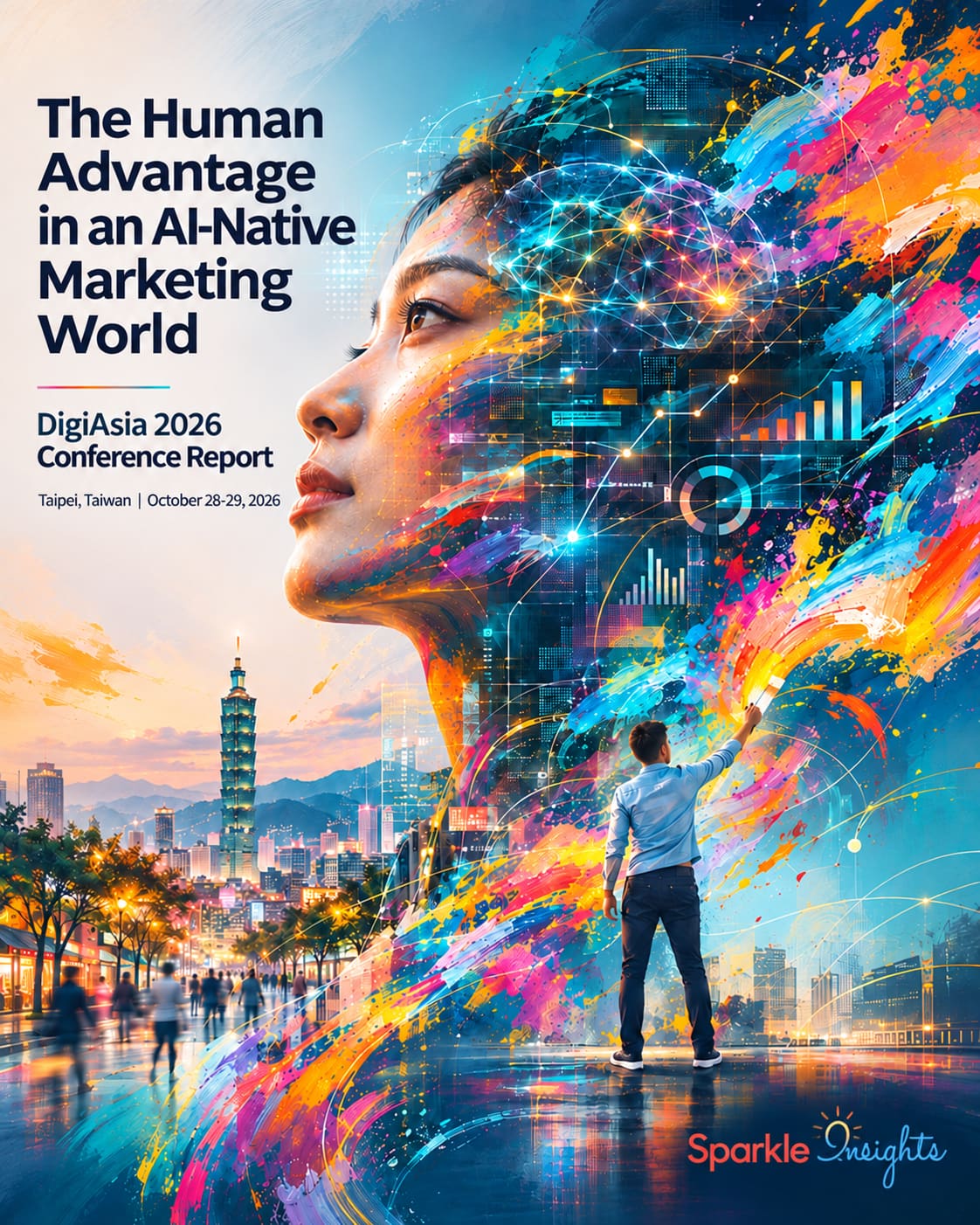
Explore the full DigiAsia 2026 conference report, The Human Advantage in an AI-Native Marketing World, for additional insights into AI-driven marketing transformation, creativity, consumer understanding, and organizational change.