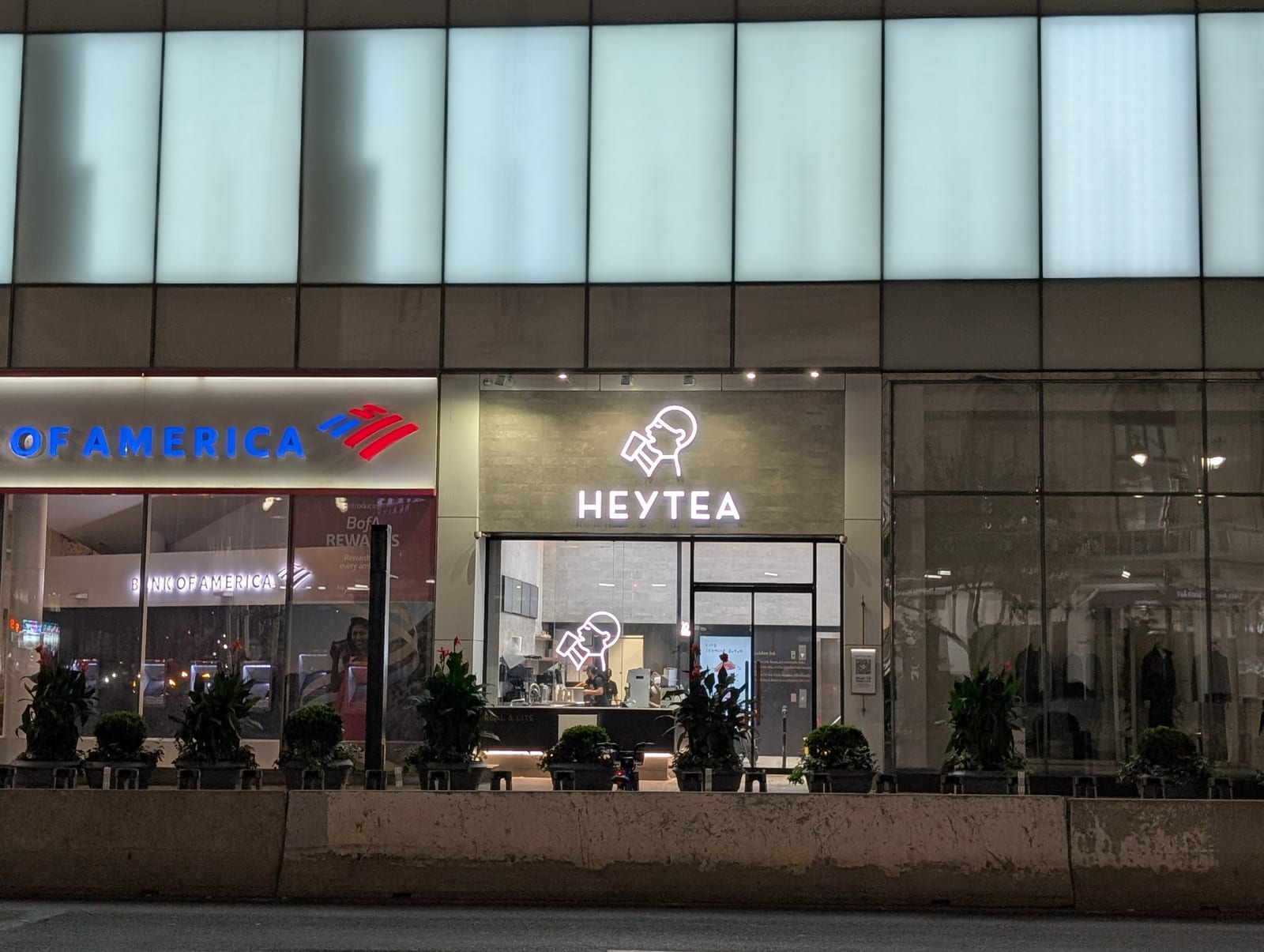
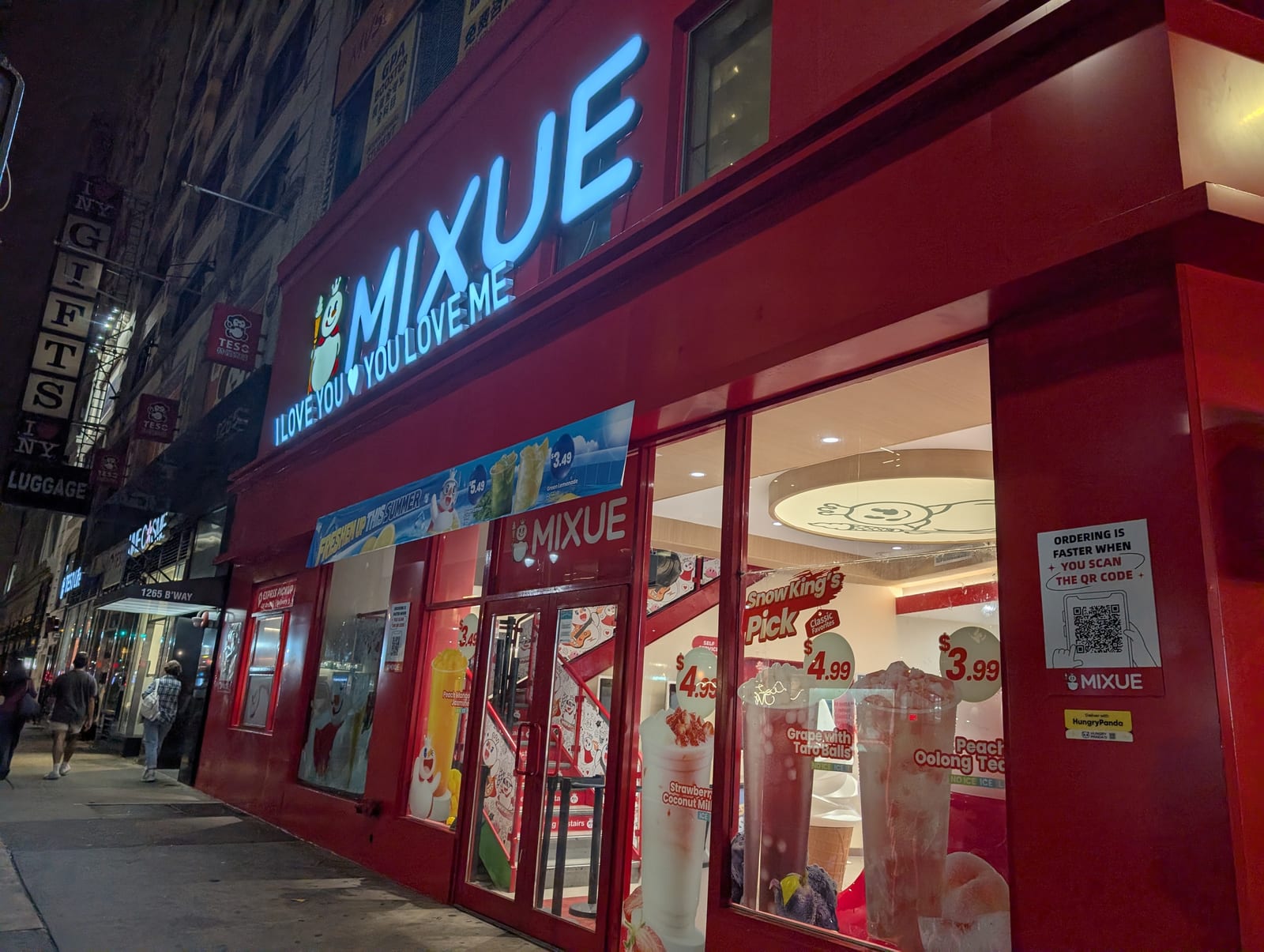
A few weeks ago, I was walking around Times Square while in New York for the 3AF Asian Marketing Summit when something caught my attention: MIXUE and HEYTEA, two brands I knew from China, had become part of the Midtown Manhattan streetscape.
It was a small but telling sign of a much bigger shift.
Chinese consumer brands are increasingly looking beyond China for growth, and the United States is becoming an important proving ground. Tea and coffee chains are among the most visible examples. HEYTEA, which opened its first U.S. store in New York in late 2023, has expanded beyond its initial beachhead. MIXUE is building a U.S. franchise network, with locations already open in New York and California and more on the way. Luckin Coffee, China's massive coffee chain, has also been steadily adding U.S. locations.
And the movement extends well beyond beverages.
Chinese sportswear giant ANTA has begun building a more visible U.S. presence around basketball and performance culture. In beauty, brands such as PROYA are moving from cross-border ecommerce toward mainstream American retail.
The opportunity is real. But entering the market is only the beginning.
For Chinese brands, the central question is no longer simply:
Can we enter the U.S.?
It is:
Can we become relevant to American consumers?
Those are very different questions.
America is not one market
Companies often talk about "localizing for the U.S." as though America were a relatively homogeneous market requiring a different language, some price adjustments and new advertising.
It isn't.
Entering the U.S. means entering one of the world's most culturally complex consumer markets.
Chinese and other Asian American consumers may be a natural first audience for some brands. They may already understand the category, recognize the brand, or be more familiar with cultural cues that require explanation elsewhere.
That can make them an effective entry point.
But for most established Chinese brands with ambitions for significant U.S. growth, they are not the endpoint.
Long-term growth requires understanding how the proposition travels across Asian, Hispanic, Black and non-Hispanic White consumers; across generations and regions; and across people with very different levels of familiarity with China, Chinese culture and Chinese brands.
Even "Asian American" is not one audience. Chinese, Indian, Filipino, Vietnamese, Korean and other consumers bring different cultural experiences, category relationships and levels of familiarity with brands from China.
The objective should not be to make a Chinese brand look American.
It should be to determine what should travel unchanged, what needs translation and what needs reinvention.
Don't confuse familiarity with relevance
Take a Chinese tea brand.
For a consumer who grew up drinking milk tea or follows Asian food trends, cheese foam, fruit tea or jasmine tea may require little explanation. The brand itself may carry cachet because the consumer encountered it while traveling in China or saw it on Chinese social media.
Another consumer may approach that same brand with no such context.
They may be asking very different questions:
Is this bubble tea? What should I order first? Is this a treat or an everyday drink? Why is it different from what I already buy?
The consumer does not necessarily need the product to become more "American." They need a reason to understand it, try it and come back.
That is where market-entry research becomes more valuable than simple localization.
A brand cannot assume that what consumers love about it in China is automatically the reason Americans will love it. Nor should it assume that unfamiliarity means the original proposition needs to be watered down.
The opportunity is to uncover the bridge between the two.
Don't erase the very thing that makes the brand interesting
There is another risk: over-localization.
International expansion has often involved sanding away cultural specificity in pursuit of something supposedly universal. But today's consumers routinely discover unfamiliar food, beauty, entertainment, fashion and cultural ideas through social media, streaming content, travel and globally connected peer networks.
Difference can be an advantage.
The mainstream growth of Korean beauty, K-pop, Japanese food and other once-niche cultural exports shows that products do not have to disguise where they come from in order to appeal broadly.
In some cases, cultural specificity is exactly what creates interest.
Chinese brands therefore should not automatically hide their origins or imitate an American incumbent.
MIXUE's Snow King mascot, HEYTEA's contemporary interpretation of Chinese tea, PROYA's identity as a Chinese beauty innovator or ANTA's credentials as a major Chinese performance brand may all become useful points of differentiation.
The question is not:
"How do we make this less Chinese?"
It is:
"Which parts of our identity create value for U.S. consumers, and what context do consumers need to appreciate them?"
That requires evidence rather than instinct.
Don't treat "mainstream" as synonymous with White consumers
This is one of the most important shifts global brands need to understand about the U.S.
Historically, marketers often treated ethnic consumers as specialized audiences and White consumers as the "general market."
That framework no longer reflects how culture moves.
Trends routinely travel across communities. A product may first gain traction among Asian consumers, be amplified by Gen Z creators, pick up momentum among Black or Hispanic consumers and eventually become something people no longer associate with any one cultural group.
The opportunity is therefore not simply to conduct an "Asian American study" first and a "general market study" later.
It is to understand how influence travels.
Who discovers the product first? Who gives it credibility? Who talks about it? Which audiences are most willing to experiment? Which cultural cues attract one group but create distance for another? At what point does something stop being viewed as a niche cultural product and become part of everyday American consumer culture?
The path from niche to mainstream is rarely linear.
Don't mistake distribution for demand
Landing a national retailer, signing franchisees or opening a flagship store creates access.
It does not automatically create consumer demand.
A Chinese beauty brand that lands on the shelves of a major U.S. retailer still has to persuade shoppers comparing it with Korean, Japanese, European and American brands that it deserves consideration.
A sportswear brand can open a highly visible flagship, but building a durable American business requires something harder: earning credibility in performance, basketball, sneaker and lifestyle culture while giving consumers a reason to choose it over entrenched competitors.
A restaurant chain can open in Times Square, but visibility and novelty do not guarantee repeat business once the excitement of discovery fades.
The U.S. market can reward novelty quickly.
Building durable relevance takes more.
Do understand the cultural meaning of the category
Localization should go deeper than translated copy, packaging or menu adjustments.
The category itself may occupy a different cultural space in the U.S.
Tea in China is embedded in centuries of culture. In the U.S., a tea brand may compete simultaneously with traditional tea, boba, coffee, functional beverages, energy drinks and social-media-driven treats.
Skincare may be evaluated through efficacy, dermatology, luxury, wellness, beauty routines or ingredient trends.
Basketball shoes are not simply athletic equipment. They sit at the intersection of performance, fashion, celebrity, music, sneaker collecting and Black American culture.
Understanding those meanings helps a brand identify the competitive frame it is actually entering.
Sometimes the most important competitor is not another Chinese brand—or even another company in the same category.
Do identify the entry audience—and then look beyond it
An entry audience can be strategically valuable.
Asian American consumers may provide an early base of familiarity and advocacy for certain Chinese brands. In some categories, they may also act as cultural translators, introducing products or experiences to friends, coworkers and broader social networks.
But brands should be careful not to turn an entry strategy into a ceiling.
A Chinese brand may see Asian American consumers as a natural starting point, while research reveals that the larger growth opportunity extends to Hispanic Gen Z consumers, Black consumers or other audiences that respond just as strongly—or even more strongly—to the proposition.
The strategic question is not only who will try us first?
It is also:
Who can take us further?
That distinction can shape everything from positioning and product strategy to creative development, media planning and retail expansion.
Do test where the brand can stretch
Strong market-entry research does more than ask consumers whether they like a concept.
It explores the boundaries of the opportunity.
Which product can serve as the gateway into the portfolio? Which audiences need little persuasion? Which require more education? Does Chinese origin create interest, hesitation or little reaction at all? Which brand elements communicate quality? Which accidentally communicate "cheap"? What does premium mean within this category? Which claims create credibility? Which cultural references travel well, and which do not?
Research can also uncover growth opportunities the company has not considered.
A beauty brand may assume its technology story should lead and discover that consumers are more intrigued by an ingredient, ritual or philosophy rooted in Chinese culture.
A food brand may assume American consumers want more familiar flavors and discover that authenticity is exactly what creates interest.
A sportswear brand may expect performance credentials to be enough and learn that cultural credibility, design language or athlete associations carry just as much weight.
Research should challenge assumptions, not simply validate them.
From Chinese success to American relevance
The conversation about Chinese brands going global needs to move beyond market entry.
The challenge is not simply China-to-U.S. localization.
It is cross-cultural growth.
At Sparkle Insights, we help global brands understand how products, positioning and creative ideas travel across cultures—so they can identify what to preserve, what to adapt and where their strongest U.S. growth audiences are.
Our SAIL framework can provide an early market-readiness assessment by examining the cultural and competitive landscape, the brand's current U.S. presence, communications and potential points of friction.
SPARK can take that further through consumer research that tests positioning, challenges assumptions, validates opportunities and identifies the audiences most likely to accelerate growth.
Because entering America should not mean stripping away what made a brand successful somewhere else.
Nor should early success with one cultural audience be mistaken for proof that the job is done.
The brands with the best chance of becoming part of American culture will understand something more nuanced:
Global brands don't have to become culturally neutral. They have to become culturally relevant.
Seeing MIXUE and HEYTEA around Times Square made China's global brand ambitions unusually visible to me.
The storefront may be the most obvious evidence that a brand has arrived.
What happens after consumers walk through the door will determine whether it becomes part of the market.