Artificial intelligence is now a strategic priority for virtually every marketing organization. Executives recognize its potential. Many have experimented with AI tools themselves, invested in enterprise platforms, and encouraged their employees to become more AI-literate.
Yet one of the hardest challenges remains: How do you motivate an entire team to embrace AI—not because they have been instructed to, but because they genuinely want to discover what they can accomplish with it?
This was the question that made Sulin Lau's presentation at DigiAsia 2026 in Taipei particularly compelling.
Speaking about her experience leading Grab's in-house marketing organization across Southeast Asia, Lau offered something more useful than another demonstration of AI's capabilities. She shared a practical approach to making AI adoption engaging, creative, and personally meaningful for employees.
Her central insight was that teaching people to use AI is not the same as inspiring them to use it.
The Challenge: Scaling a Marketing Team Without Losing Its Soul
Grab has evolved far beyond its original ride-hailing business. Today, its ecosystem encompasses food delivery, groceries, financial services, and other businesses across Southeast Asia.
Lau described how her marketing organization has had to support this expanding portfolio without a corresponding increase in team size.
AI offers an obvious opportunity: automate repetitive work, accelerate research, increase creative output, and enable teams to accomplish more with existing resources.
But Lau recognized a problem with making efficiency the primary motivation.
For marketers, designers, researchers, and other creative professionals, the promise of doing more work in less time is not necessarily inspiring. In some cases, it may even be discouraging.
Employees want opportunities to develop their capabilities, express their creativity, contribute meaningful ideas, and be recognized for their achievements.
Lau's challenge, therefore, was not simply to introduce AI tools. It was to create an environment in which people saw AI as a way to expand what they could do professionally.
Her approach offers five important lessons.
1. Inspire People with Possibilities, Not Just Productivity
Rather than framing AI primarily as a tool for doing existing work faster, Lau encouraged her team to imagine things that would previously have been impossible because of time, budget, or practical constraints.
One example involved Grab drivers.
Across Southeast Asia, Grab drivers possess extensive local knowledge. They know neighborhoods, restaurants, routes, attractions, and the everyday realities of the communities they serve.
In many ways, they are natural ambassadors for their cities.
Yet most drivers lack the time, resources, or skills to become social media creators.
Grab explored how AI avatar technology could change that. By compensating selected drivers for the use of their stories, voices, likenesses, and local knowledge, the company could help transform them into digital ambassadors capable of introducing destinations to travelers in multiple languages.
The idea was not simply to produce content more efficiently. It was to create a new marketing possibility by combining authentic human knowledge with AI-enabled scale.
For employees, this is a more exciting proposition than being told to automate another repetitive task.
The leadership lesson: Start by asking what your team has always wanted to accomplish but could not. AI adoption becomes more motivating when employees see it as a means of realizing ambitions rather than just increasing productivity.
2. Let Employees Become Builders, Not Just Users
One of the most interesting initiatives Lau described began in December 2025.
Instead of prescribing AI projects from the top, Grab invited employees to consider three questions:
- What are the tasks you dislike doing?
- What tools or capabilities do you wish you had?
- What would you like to accomplish that was previously impossible?
Employees could then organize themselves into groups and develop solutions to problems they personally cared about.
Participation was voluntary.
According to Lau, the initiative attracted 122 participants working on 57 projects.
The projects were not limited to engineers or technically trained employees. Marketers, researchers, PR professionals, and other specialists were encouraged to become what are often called citizen developers—people who build useful applications without being professional software engineers.
The organization provided approved AI tools, governance requirements, and guidance around appropriate resources and safeguards. Within those boundaries, employees had considerable ownership over their projects.
This created a different relationship with technology.
Instead of waiting for an IT department or an external vendor to develop a tool, employees could begin imagining and prototyping solutions themselves.
Some teams explored similar problems independently, compared their approaches, and learned which solutions worked better.
The leadership lesson: Giving employees control over the problems they solve can be more powerful than assigning them standardized AI exercises. Ownership creates motivation, while practical experimentation builds capability.
3. Recognize AI Development as a New Form of Creativity
Grab did not treat employee-built AI solutions merely as technical improvements.
Lau argued that developing a useful AI application can itself be a creative achievement—one worthy of the same recognition traditionally given to advertising, design, or storytelling.
Grab began showcasing selected projects through short internal presentations and celebrating their creators with recognition and awards.
The examples illustrated how different professional disciplines could contribute to AI innovation.
A PR professional in Indonesia explored generative-engine optimization, extending his expertise in communications into a new technical field.
Researchers developed Morpheus, a tool designed to explore Grab's extensive proprietary survey data through AI-mediated simulations. Lau described a research database containing millions of question-and-answer records linked to actual respondents.
The distinction is important: although the system draws on real research records, its simulated conversations should not be confused with newly conducted interviews with those consumers. Such tools can support exploration and hypothesis development, but their outputs still require appropriate validation.
Lau and fellow planners also developed an AI-powered planning assistant that challenged weak briefs, questioned vague objectives, and prompted users to consider alternative strategic directions.
Rather than behaving like an assistant that simply agrees with everything, it was designed to act more like a demanding strategic planner.
These examples demonstrate that AI can help professionals extend their expertise into new forms of problem-solving.
A researcher can become a tool builder. A communications specialist can develop a new analytical capability. A strategist can translate professional judgment into an interactive system that supports colleagues.
By celebrating these achievements, Grab reinforced the idea that AI innovation was not reserved for a small technical elite.
The leadership lesson: Recognize not only the people who use AI effectively, but also those who invent new applications for it. Make experimentation and knowledge-sharing visible forms of professional achievement.
4. Make Time for Play—and Treat It as Real Work
Perhaps Lau's most memorable recommendation to leaders was to make time for play.
Traditional AI training often focuses on demonstrations, tutorials, and instructions. These can teach employees the mechanics of using a tool, but they do not necessarily inspire curiosity.
Grab took a different approach.
The company organized creative challenges, competitions, and hackathons designed to make AI exploration enjoyable and collaborative.
One initiative used a game-like format to introduce employees to generative-engine optimization and the challenge of making brands visible in AI-generated answers.
Another invited employees to create AI-assisted microdramas, including scripts, trailers, and episodes.
Lau reported that the competition produced 43 films, with participation extending beyond employees in traditional creative roles.
These activities did more than teach technical skills.
They gave employees permission to experiment, take creative risks, discover unfamiliar capabilities, and learn from one another.
Importantly, they also made learning social.
Participants could see what colleagues were creating, compare approaches, share discoveries, and celebrate the results.
There is an important difference between asking employees to complete an AI training module and giving them an engaging creative challenge they want to solve.
The former may generate compliance. The latter can generate curiosity.
The leadership lesson: AI experimentation should not be limited to formal training. Create regular opportunities for employees to explore, compete, collaborate, and play within appropriate organizational safeguards.
5. Turn Experimentation into Real Business Value
Grab's creative exercises were not entirely separate from business objectives.
Lau described a hackathon challenge based on the company's abandoned food-delivery carts.
One team's idea imagined abandoned carts as characters expressing emotions such as loneliness, disappointment, and frustration, connected to the food left behind.
The concept eventually progressed into a creative execution.
What made the story particularly meaningful was that it originated from a CRM team rather than a conventional creative department.
Employees who might not previously have regarded themselves as creative professionals developed an idea that reached a broader audience.
This illustrates a potentially transformative aspect of AI adoption.
AI does not simply make existing specialists more productive. It can lower the practical barriers that prevent people in different functions from expressing ideas and contributing beyond their traditional roles.
The result may be greater cross-functional creativity, not merely greater efficiency.
Lau also discussed Grab's merchant-facing AI tools, which extend personalized assistance to small merchants who might otherwise have limited access to business advice.
These examples suggest a broader opportunity: using AI to expand the reach of professional capabilities, whether inside an organization or across a customer ecosystem.
The leadership lesson: Give experimentation a pathway to implementation. Employees are more likely to remain engaged when promising ideas can become real products, services, or marketing initiatives.
A Practical Roadmap for Organizational AI Adoption
Grab's experience suggests that organizations should think about AI adoption as a progression from access to engagement, experimentation, and meaningful application.
For marketing leaders and agency executives, a practical starting point could look like this:
| Stage | Leadership action | Desired outcome |
|---|---|---|
| 1. Enable | Provide approved tools, training, governance, and appropriate access | Employees can experiment safely |
| 2. Invite | Ask employees what frustrates them and what they wish they could accomplish | Personally meaningful use cases emerge |
| 3. Empower | Let employees choose problems and develop solutions individually or in teams | Greater ownership and capability |
| 4. Celebrate | Showcase projects, encourage peer learning, and recognize creativity | Experimentation becomes culturally valued |
| 5. Scale | Evaluate useful solutions and integrate promising projects into workflows | Innovation produces lasting organizational value |
This is an adaptation of the principles demonstrated in Lau's presentation, rather than a formally documented Grab implementation framework.
Organizations also need to be realistic about constraints.
Not every employee will want to build applications. Not every experiment will succeed. And enthusiasm cannot replace proper security, data governance, accuracy testing, or human accountability.
The objective should not be to turn everyone into a software engineer.
It should be to help people identify where AI can extend their professional capabilities and give them practical opportunities to explore those possibilities.
What Should Leaders Measure?
Many organizations evaluate AI adoption through software licenses, training completion, or usage frequency.
Those measures can indicate whether employees have access to AI, but they reveal relatively little about whether AI is improving the organization.
A more meaningful assessment would also consider whether employees are solving problems that previously went unaddressed, contributing ideas beyond their traditional responsibilities, sharing useful practices with colleagues, and developing solutions that improve work quality or customer outcomes.
Employee engagement matters as well.
Are people enthusiastic about exploring AI? Do they feel more capable? Are they learning from colleagues? Do they see AI as a threat, an obligation, or an opportunity?
These questions do not replace conventional performance metrics. They complement them by examining whether the organization is developing the culture needed for sustained innovation.
Grab's presentation provided compelling illustrations of participation and creativity. However, the examples do not by themselves establish that every initiative improved productivity, employee retention, or business performance. Those outcomes would require additional measurement.
The Bigger Lesson: AI Transformation Is a Leadership Challenge
What stood out about Lau's presentation was not that Grab had access to sophisticated technology.
Many organizations do.
It was her understanding that the success of AI adoption depends on what employees feel empowered and motivated to do with that technology.
Leaders may recognize the importance of AI and be proficient users themselves. But individual executive enthusiasm does not automatically translate into organization-wide transformation.
Employees bring different levels of confidence, curiosity, experience, and concern to AI. Some quickly embrace new tools. Others need a compelling reason to change established ways of working.
The challenge is to create an environment where people can discover those reasons for themselves.
Grab's experience offers a useful reminder that organizational transformation is not accomplished simply by introducing new systems or requiring employees to complete training.
It requires leadership that encourages exploration, supports experimentation, celebrates achievement, and creates opportunities for people to expand their professional potential.
At DigiAsia 2026, many speakers demonstrated how AI is transforming marketing strategy, media, research, and creative production.
Sulin Lau's contribution added another essential dimension: how to bring people along in that transformation.
The organizations that benefit most from AI may not be those that simply introduce the most tools, but those that inspire their people to imagine and build what was previously impossible.
This article is based on Sulin Lau's presentation, “Without AI, Soul Cannot Scale,” at DigiAsia 2026 in Taipei, October 29, 2026. The examples and figures attributed to Grab were presented during the session and have not been independently audited. Analysis and recommendations are by Sparkle Insights.
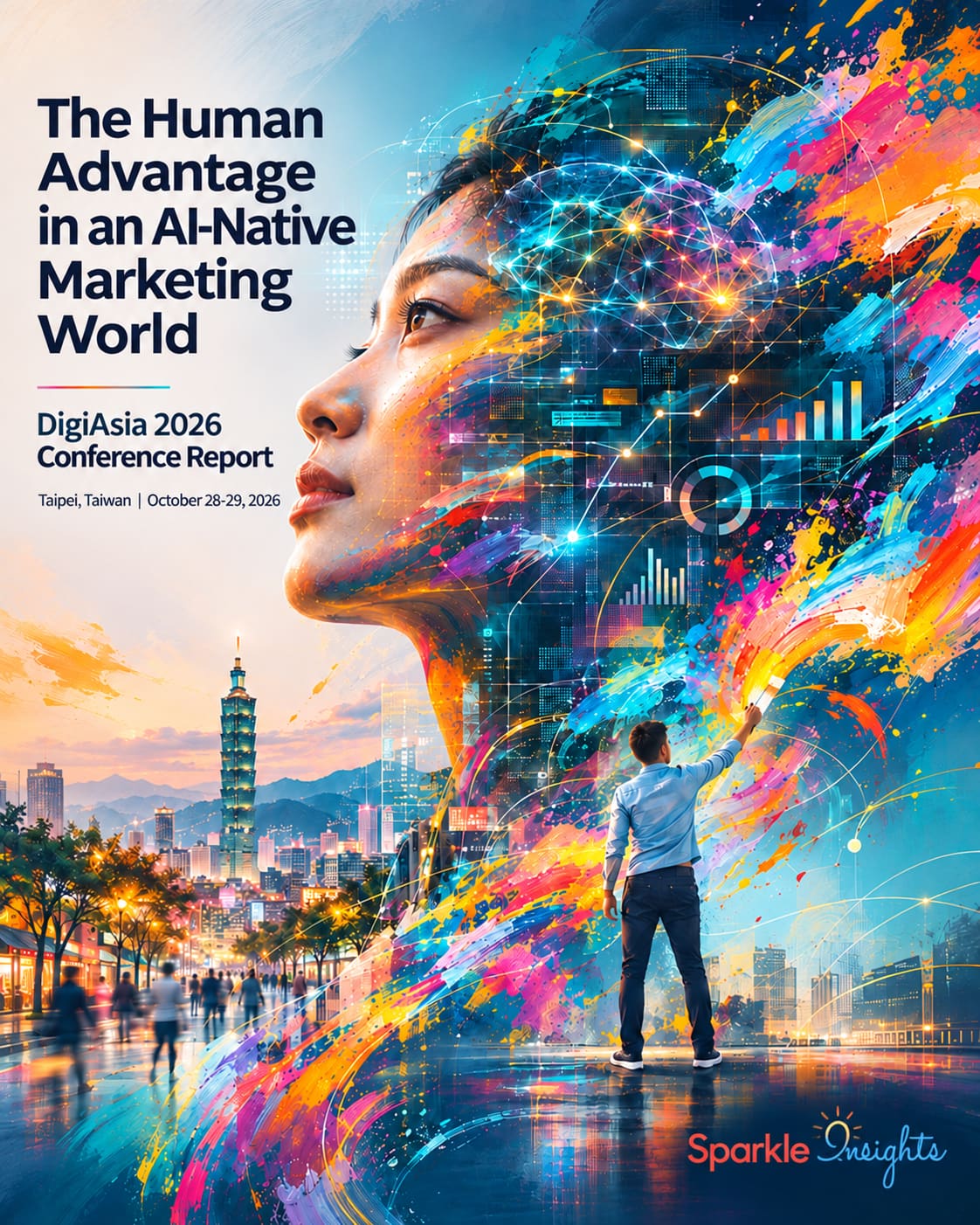
For a broader perspective on AI's implications for marketing, explore Sparkle Insights' DigiAsia 2026 Conference Report, The Human Advantage in an AI-Native Marketing World.