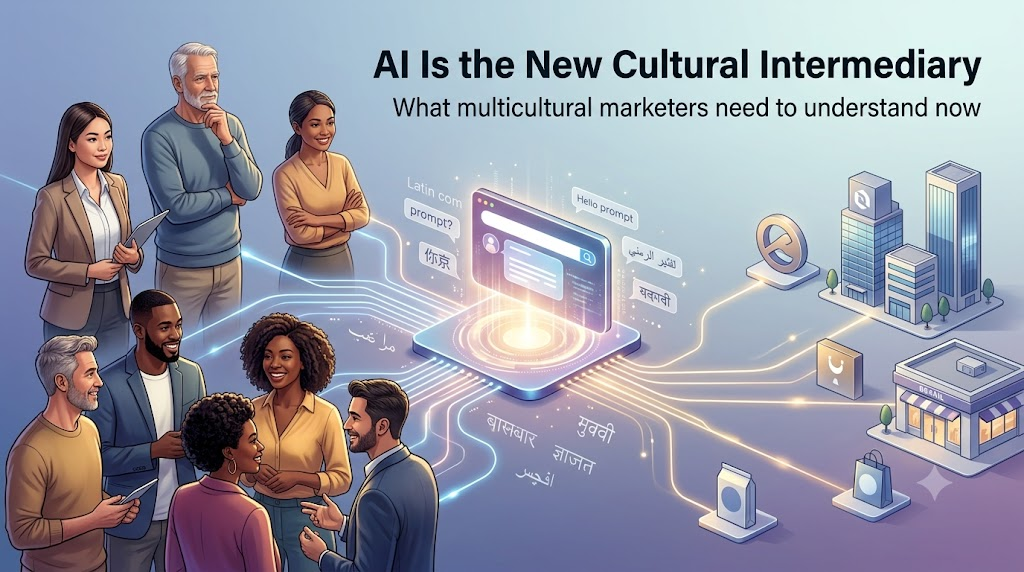
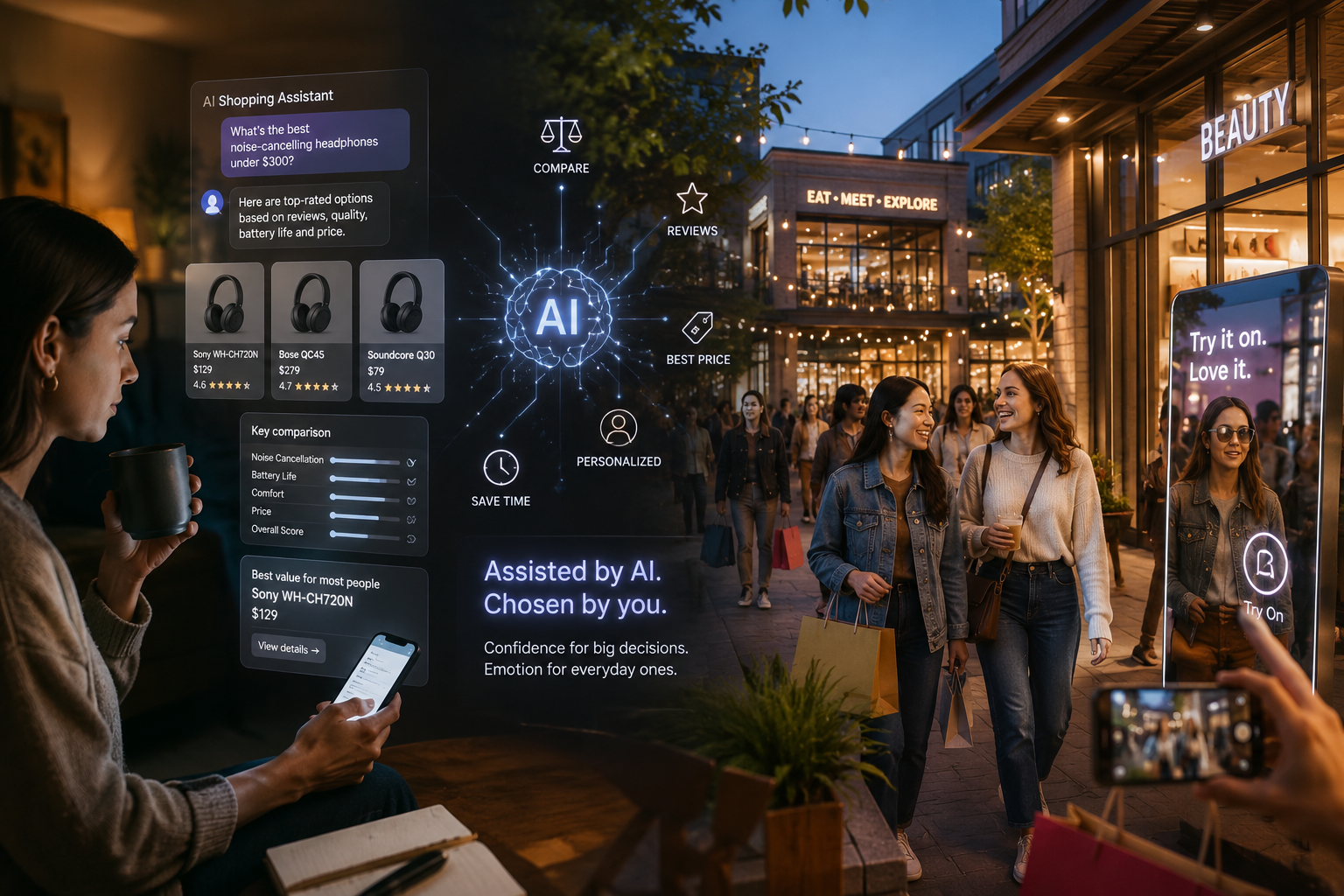
Artificial intelligence is quickly changing how people discover brands, products, content, and ideas. Search is becoming conversational. Social platforms are becoming shopping environments. Retailers are using AI to predict trends before they fully surface. Consumers are beginning to ask AI tools for recommendations that once came from search engines, influencers, friends, store associates, review sites, or brand websites.
For marketers, this shift is enormous. Discovery is no longer only about being visible in a search result, showing up in a social feed, or winning shelf space. Increasingly, brands must consider how they appear inside an AI-generated answer, recommendation, summary, comparison, or shopping journey.
But there is a danger in seeing this as only a technology story.
AI may reshape how discovery happens. Culture still determines whether people trust what they discover.
That distinction matters. A recommendation is not the same as persuasion. A product suggestion is not the same as relevance. An AI-generated answer may help consumers narrow their options, but it does not automatically make a brand feel credible, meaningful, aspirational, safe, or right for them.
Trust is still human. And trust is still cultural.
The New Discovery Layer
For years, brands have optimized for search, social, retail media, influencer ecosystems, and ecommerce platforms. Each channel had its own rules. Search rewarded authority and relevance. Social rewarded participation and attention. Retail rewarded availability, ratings, and price. Influencers rewarded authenticity, taste, and parasocial trust.
AI is now adding a new layer across all of these systems.
Instead of typing a query and scanning pages of results, consumers can ask a tool for the “best,” “most affordable,” “most trusted,” “best for me,” or “worth it” option. Instead of comparing dozens of reviews, they can ask for a summary. Instead of browsing endlessly, they can receive a curated shortlist. In shopping, travel, healthcare, financial services, entertainment, food, beauty, and retail, AI is beginning to act as a filter between consumer curiosity and brand consideration.
This creates a new strategic challenge: brands must understand not only how people search, but how people delegate discovery.
When consumers ask AI for help, they are outsourcing part of the decision process. They are asking a system to simplify complexity, reduce effort, and provide confidence. That can be convenient, but it also raises new questions:
- What sources does the AI appear to trust?
- What language does it use to describe a brand?
- Which attributes does it prioritize?
- Which brands does it omit?
- Does the answer reflect how consumers actually make decisions?
- Does the recommendation feel culturally relevant to different audiences?
The winners in this new environment will not simply be the brands that appear in AI-generated responses. They will be the brands that convert AI-mediated discovery into human trust.
The Difference Between Visibility and Believability
Marketers often treat discovery as a visibility problem: how do we get found? That remains important. But AI makes another question more urgent: once we are found, do we feel believable?
Believability is not created by algorithmic presence alone. It is shaped by context, identity, lived experience, social proof, language, values, and cultural fluency.
A Gen Z shopper may not trust a beauty recommendation just because it is ranked first. They may want to know whether real people with their skin tone, style, budget, or values have embraced it. A multicultural consumer may not trust a financial services message if it does not acknowledge family decision-making, immigration context, language dynamics, or community norms. An Asian American consumer may not respond to a generic “diverse audience” message that fails to recognize the complexity of ethnicity, generation, acculturation, and identity.
AI can summarize options. Culture explains why one option feels right.
This is why cultural insight becomes more important, not less, in an AI-shaped marketplace. As AI compresses information, brands need deeper understanding of the emotional and cultural signals that create confidence.
Why Culture Still Determines Trust
Trust is rarely built from information alone. People trust when something feels familiar enough to be understood, credible enough to be considered, and meaningful enough to matter.
Culture shapes all three.
Culture influences what people consider expert, authentic, premium, safe, innovative, responsible, or desirable. It shapes whose recommendation matters. It shapes whether a message feels inclusive or performative. It shapes how people interpret price, quality, convenience, tradition, novelty, privacy, status, wellness, and risk.
This is especially important as consumers become more aware that AI systems are not neutral. They can flatten nuance, reproduce bias, over-prioritize dominant sources, or miss emerging cultural signals that have not yet been widely documented. In other words, AI may be powerful at organizing existing information, but it may be weaker at understanding meaning in motion.
Culture is meaning in motion.
It lives in conversations, communities, rituals, aesthetics, tensions, jokes, aspirations, anxieties, and contradictions. It shows up in why one phrase feels empowering and another feels pandering. It explains why a campaign can be technically inclusive but emotionally disconnected. It reveals why a product trend may explode in one community and stall in another.
For brands, this means the future of discovery cannot be reduced to AI optimization. It must include cultural interpretation.
Gen Z Shows What Is Coming
Gen Z offers a useful preview of this shift. They are comfortable moving across search, social, video, creators, communities, and AI tools. Their discovery behavior is fluid. They may encounter a brand on TikTok, validate it on Reddit, compare it through AI, check reviews on Amazon, look for creator proof, and then decide whether the brand fits their identity.
This generation does not separate information from culture. They evaluate brands through tone, values, aesthetics, community signals, and perceived authenticity. They are quick to detect when a brand is trying too hard. They are also willing to revive, reinterpret, and elevate brands that give them room for self-expression.
That is why some legacy brands have found new relevance with younger consumers. They are not simply advertising to Gen Z; they are being recontextualized by Gen Z. The brand becomes a material that young consumers can use to express taste, irony, nostalgia, ambition, individuality, or belonging.
AI can help Gen Z discover options. But culture helps determine which options become part of identity.
Multicultural Consumers Make the Trust Question Even More Urgent
For multicultural audiences, the gap between discovery and trust can be especially wide.
Many brands still under-segment multicultural consumers or rely on broad representation rather than deep cultural relevance. AI could intensify this problem if it reflects the same limited source material, generic assumptions, or dominant-market framing that has historically shaped brand strategy.
For example, Asian American consumers are often treated as a single audience despite enormous differences by ethnicity, language, generation, geography, religion, income, category behavior, and media habits. Hispanic, Black, immigrant, bicultural, and mixed-race consumers also bring layered identities and context-specific trust signals that generic models may not fully capture.
The risk is not only that AI gives incomplete answers. The greater risk is that brands mistake AI-generated simplification for consumer understanding.
A brand may appear in the right answer and still fail in the real moment of decision because the message, imagery, claims, spokesperson, channel, or experience does not feel culturally credible.
For multicultural strategy, the mandate is clear: do not let AI flatten the consumer. Use AI to detect patterns, but use cultural research to understand meaning.
What This Means for Brands
The brands that succeed in the next era of discovery will treat AI, culture, and trust as connected strategy questions.
First, brands need to understand how consumers are using AI in their category. Are they using it for education, comparison, reassurance, deal-seeking, planning, inspiration, or decision validation? Different uses create different trust needs.
Second, brands need to study what AI systems say about them. How are they described? Which competitors are mentioned? Which attributes are emphasized or missing? Are multicultural needs, values, and use cases represented accurately?
Third, brands need to identify the human trust signals that matter most. These may include peer proof, expert endorsement, creator credibility, community validation, family approval, cultural specificity, transparency, convenience, or brand heritage.
Fourth, brands need to pressure-test whether their messaging travels across cultural contexts. A message that works for a general market audience may not create the same confidence among Asian American consumers, Gen Z audiences, immigrant families, bilingual households, or culturally hybrid consumers.
Finally, brands need to build feedback loops between AI-driven signal detection and human-centered research. AI can help surface what is changing quickly. Qualitative, quantitative, and hybrid research can explain what those changes mean and what brands should do about them.
The Role of Human Insight in an AI-Mediated Market
The rise of AI does not make research less important. It changes what research must do.
Research can no longer be only a snapshot of attitudes at a single point in time. It needs to help brands interpret fast-moving behavior, understand cultural context, and make decisions amid uncertainty.
This is where human insight becomes a competitive advantage. Consumers do not always know how to explain why they trust something. They may not articulate the cultural codes guiding their choices. They may say they want convenience but actually choose based on identity, reassurance, status, or belonging. They may adopt a technology quickly in one context and reject it in another.
Good research uncovers these tensions. Good strategy translates them into action.
In an AI-mediated market, the most valuable insights will come from connecting what machines can detect with what only humans can interpret: emotion, culture, contradiction, identity, and meaning.
A Better Question for Marketers
The question is not simply, “How do we show up in AI discovery?”
The better question is: “When AI helps consumers find us, what gives them a reason to trust us?”
That reason may be functional. It may be emotional. It may be cultural. Most likely, it is all three.
Brands should be preparing now for a world where discovery is increasingly automated, but trust remains deeply human. They will need to understand how AI shapes the consideration set, how social and cultural signals validate decisions, and how different communities define credibility.
AI may become the new front door to discovery. But culture is still what invites people in.
Sparkle Point of View
At Sparkle Insights, we believe the future of brand discovery will belong to companies that can combine technological awareness with cultural intelligence. AI can help brands move faster, detect signals earlier, and understand the changing shape of consumer journeys. But it cannot replace the work of listening deeply, interpreting context, and understanding why people believe what they believe.
For brands, the opportunity is not to choose between AI and human insight. It is to bring them together.
AI can show what is being surfaced. Research can reveal what is being trusted.
And in the next era of marketing, that difference will matter more than ever.