World Cup 2026 offered brands an unusually visible demonstration of how Asian and Asian American consumers participate in global culture.
The tournament did not produce one unified “Asian fan” audience. It activated multiple communities through heritage-team loyalty, support for Team USA, local identity, family relationships, language, entertainment and interest in the wider cultural experience surrounding soccer.
It also revealed that Asian American audiences do not necessarily rely on one media system. Many appear to assemble their World Cup experience from three overlapping sources:
- U.S. general-market media for live access and the shared national spectacle
- Media from Asian countries for heritage-team expertise and emotional depth
- U.S. Asian and Asian-language media for community, identity and local relevance
For brands, the post-tournament opportunity is not simply to continue using soccer imagery once the excitement fades. The deeper task is to understand how globally connected consumers move among cultures, media sources and identities, and how those same behaviors can inform a broader approach to Asian American marketing all year long.
Asian American Soccer Interest Was Already Substantial
The World Cup did not introduce Asian Americans to soccer. Nielsen reported that 33% of Asian Americans were interested in the sport ahead of the tournament, compared with 28% of the U.S. population overall. It also found that soccer is the leading sport across many Asian markets, giving numerous Asian American households a cultural relationship with the game that predates the tournament’s arrival in North America.
That connection, however, does not look the same across communities. It arrives through different doors, carries different weight and means different things depending on who is watching and why.
For some immigrants and first-generation Americans, soccer is a familiar part of life in their country of origin. For some second- and third-generation consumers, it provides a periodic connection to family heritage. Others enter through American youth soccer, international clubs, friends, creators, fashion, music or the social energy of a global event.
A useful Asian American sports strategy therefore cannot begin and end with ethnicity. It must consider:
- Heritage country and immigration generation
- Language and media habits
- Strength of identification with a national team
- Support for Team USA
- Local community and host-city involvement
- Level of soccer knowledge
- The role of family and friends
- Interest in the cultural experience beyond the match
Heritage-Team Fandom Became Community Participation
Some of the clearest examples surfaced in Korean and Japanese American communities. In both cases, a national team became the occasion for something much larger than a match. The game supplied the calendar. The community supplied the meaning.
In Los Angeles, Korean American organizations and businesses prepared large-scale Koreatown watch parties around South Korea’s matches. The organizing coalition included more than a dozen community groups, while events incorporated large screens, performances, food vendors, sponsor booths and public-safety planning.
This was more than a group of individuals watching a game. The national team became a platform for activating an ethnic commercial district, strengthening community visibility and creating a collective expression of Korean identity in the United States.
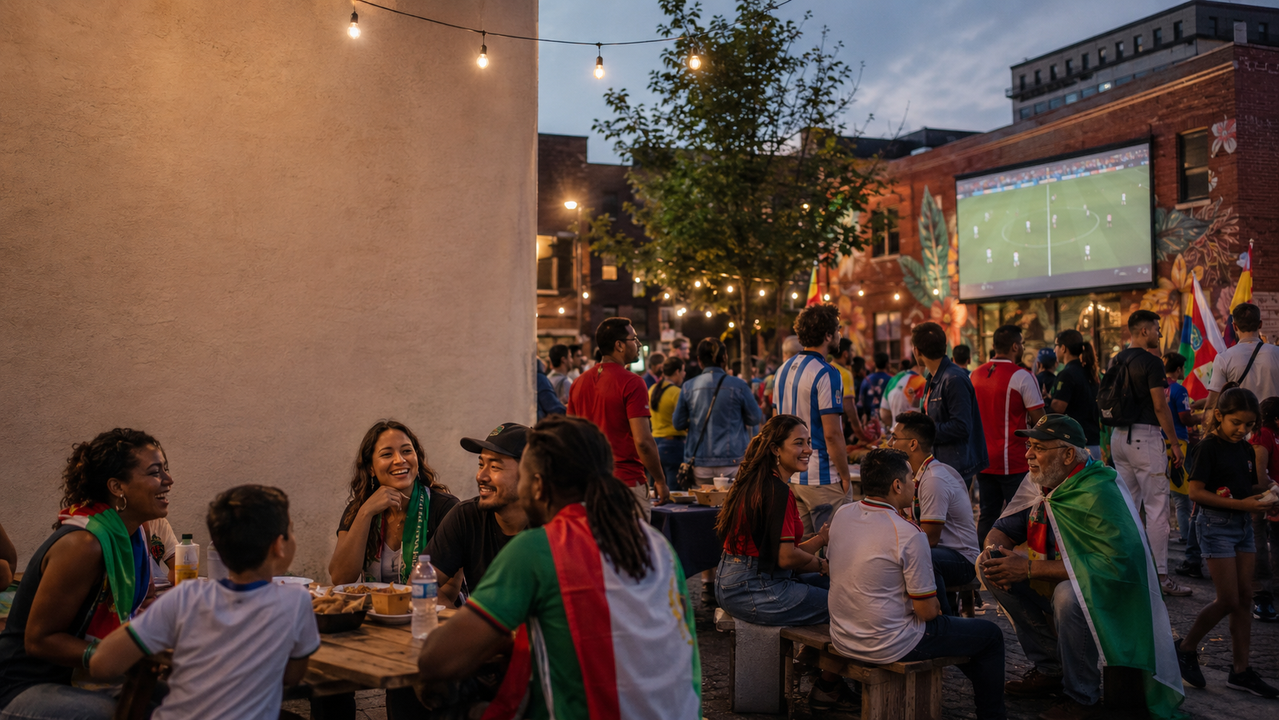
In Little Tokyo, more than 1,000 supporters gathered for Japan’s match against the Netherlands. The event brought together Japanese nationals, Japanese Americans, mixed-generation families, community institutions, merchants and fans with no Japanese background. Local organizations operated booths, children made flags and neighborhood businesses participated in the surrounding festival.
The coverage also captured layered identity. One Japanese American father described supporting both Japan and the United States, while other participants expressed surprise at the number of non-Japanese fans supporting the team.
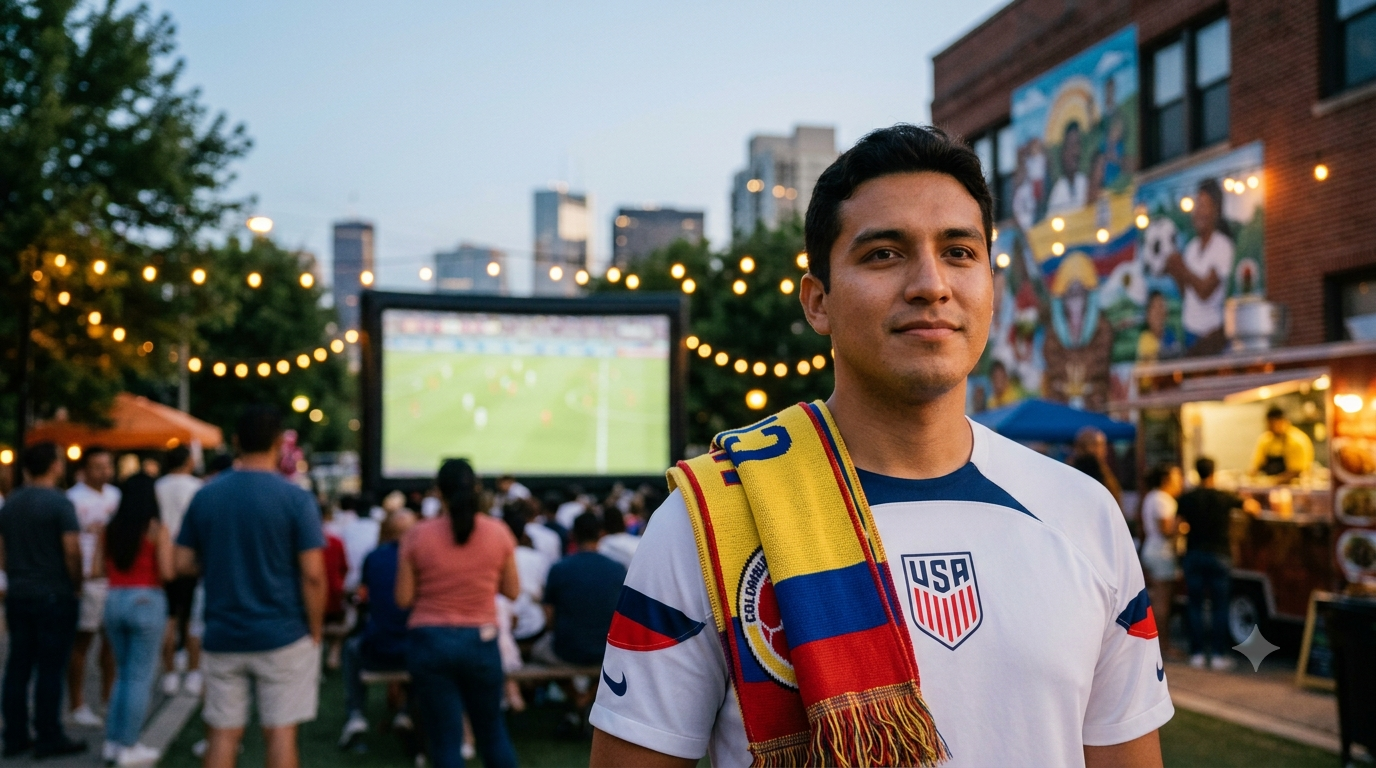
These examples challenge the assumption that national-team loyalty is exclusive. Asian American consumers may support a heritage nation and Team USA simultaneously. Their fandom can express an additive identity rather than a choice between being American and being Asian.
The Brand Implication
Campaigns should not force consumers into a single national affiliation. Brands have an opportunity to recognize dual loyalty, mixed-heritage households and the ways families negotiate different team allegiances.
The most useful segmentation is not simply “Korean,” “Japanese” or “Asian.” It distinguishes among heritage-team loyalists, dual supporters, global soccer fans, casual cultural participants and people drawn into the tournament through family or community.
Not Every Asian American Community Had a Heritage Team
The Filipino American experience illustrates a different form of engagement altogether. Here the organizing principle was not a home team to rally behind, since there was none, but a set of connections that formed anyway. Absence, it turned out, did not mean disengagement.
Because the Philippines did not participate in the men’s tournament, there was no single Philippine team around which Filipino American audiences could organize. Participation may instead have come through Team USA, another national team, mixed-nationality families, local host-city events, creators or the broader entertainment environment.
Filipino American media found alternative connections. Asian Journal, for example, highlighted Filipino American designers and creatives whose work contributed to official World Cup projects in New York/New Jersey, San Francisco and Los Angeles.
That framing shifted the story in a subtle but meaningful way. The question moved from “Which team do Filipino Americans support?” to “How are Filipino Americans contributing to the event?” One question looks for allegiance. The other looks for agency, and it tends to find far more.
The Brand Implication
A heritage-country qualification model is too narrow for multicultural sports marketing. Brands need to investigate how communities participate when their country of origin is absent.
Filipino American audiences may be especially useful for understanding the culturally engaged casual fan: someone who participates enthusiastically through social relationships, entertainment, local events or another team without possessing an inherited allegiance to a World Cup participant.
Asian Teams and Culture Attracted Crossover Participation
Asian cultural specificity did not necessarily confine these events to a single ethnic audience. If anything, the opposite happened. Specificity became a draw, pulling in people who arrived out of curiosity and stayed because the experience felt real.
The Little Tokyo watch party attracted supporters from outside the Japanese community, including families whose interest began through Japanese food, local culture or youth soccer.
This reflects a broader pattern in U.S. culture. Nielsen has identified growing crossover interest in Asian-led talent and cultural properties beyond AANHPI audiences.
For brands, this is an important corrective to the belief that culturally specific content automatically limits reach. Asian culture can function as an entry point for wider audiences, provided the brand does not remove the context that made the experience distinctive.
The opportunity is not to sand Asian culture down into something more generic and therefore, in theory, more marketable. The real work runs in the other direction. It means making culturally grounded experiences accessible to a wider audience without flattening the meaning that gave them their pull in the first place.
Three Media Systems Shaped the Asian American World Cup Experience
One of the most important lessons of the tournament concerns media behavior rather than the matches themselves. How Asian American audiences watched turned out to be as revealing as what they watched. The pattern that emerged was less a single channel than a system of them, each doing a distinct job.
There is not yet a comprehensive post-tournament dataset showing exactly how Asian Americans divided their viewing among U.S. broadcasters, home-country platforms and U.S. Asian media. The available evidence, however, supports a multilayered media model.
Different sources performed different jobs, and no single one carried the whole experience. Understanding which source did what is the first step toward planning around them.
1. U.S. General-Market Media Delivered the Shared Spectacle
U.S. rights-holding broadcasters were the most straightforward destination for live match access. They supplied the common tournament feed, national conversation, major highlights and coverage of Team USA and globally prominent teams.
For English-dominant and U.S.-born Asian Americans, mainstream television, streaming platforms and social highlights were likely central to match viewing.
Watching a match through a U.S. broadcaster, however, does not mean the viewer depended on that broadcaster for every part of the experience. The live feed was only one piece. A fan could watch the game through a U.S. service and then turn elsewhere entirely for heritage-team analysis, community reactions or commentary that felt culturally familiar.
2. Asian-Country Media Supplied Insider Knowledge and National Emotion
Media in countries such as Japan and South Korea could devote far more attention to their national teams than a U.S. general-market broadcaster serving the entire tournament.
Home-country coverage could assume familiarity with:
- The players and coaching staff
- Domestic football debates
- Historical tournament performance
- National expectations
- Tactical choices
- Players competing in overseas leagues
- The emotional significance of a result
This gives bilingual and immigrant audiences something general-market coverage usually cannot: depth without the need to explain the cultural background.
For Asian Americans connected to a participating nation, home-country media could supply the analysis and emotional tone of an insider conversation. It spoke to them as people already fluent in the story, not as newcomers who needed the basics explained. That shorthand is precisely what general-market coverage, built for the broadest possible audience, is rarely able to offer.
In countries whose national teams did not qualify, the media role was different. China, for example, still represented a major football and commercial market. China Media Group finalized a tournament broadcasting agreement shortly before the World Cup, even though China did not participate.
Such coverage could organize itself around international stars, tournament business, Asian football development and the continuing national debate about domestic soccer performance.
The category “home-country media” also extends beyond conventional television. Asian American consumers may have followed:
- Broadcaster clips on YouTube
- Sports portals and apps
- Podcasts and livestreams
- Short-form video commentators
- Player and team accounts
- Links circulated through family messaging groups
The home-country media relationship is therefore increasingly digital, selective and social. It rarely looks like sitting down for a scheduled broadcast anymore. More often it is a clip forwarded by a cousin, a livestream caught on a phone or a thread of reactions traded between games.
3. U.S. Asian Media Localized the Tournament
U.S. Asian outlets played a distinctive bridging role that neither of the other systems could fill. They sat between the home country and the neighborhood, fluent in both. That vantage point let them tell a story the larger players tended to miss entirely.
Home-country media explained what the World Cup meant to the nation. U.S. Asian media explained what it meant to the diaspora, the neighborhood and the experience of living in America.
Korean American media provided schedules, travel information, local viewing guides and coverage of Koreatown preparations.
Rafu Shimpo documented Little Tokyo organizations, local merchants, family participation and dual Japanese-American loyalty alongside Japan’s performance.
Asian Journal highlighted Filipino American creative participation and the perspective of Filipino journalists engaging with a major event even without a Philippine national team.
These were stories that neither a national broadcaster in Asia nor a U.S. general-market sports network was likely to prioritize. They were too local for one and too specific for the other. That gap is exactly where U.S. Asian media earned its relevance.
U.S. Asian media could address questions such as:
- Where are local watch parties taking place?
- How are Asian commercial districts participating?
- Which community organizations are involved?
- How do fans balance U.S. and heritage-country loyalty?
- Which Asian Americans contributed to the tournament?
- Did neighborhood businesses benefit?
- How is the event experienced by mixed-generation families?
Broadcasters Such as KTSF and Crossings TV Occupy a Hybrid Position
The line between “home-country media” and “U.S. Asian media” is not always a clean one. Some outlets sit squarely on top of it, drawing from both sides at once. A few examples show how blurred that boundary has become.
KTSF combines locally relevant Bay Area programming with Chinese-language and other Asian programming sourced from overseas. Its schedule includes content such as China News, ETTV News, India Waves and other Asian-language programs.
Crossings TV distributes programming across Filipino, Chinese, Korean, Vietnamese, Hmong and South Asian audiences. It functions less like one pan-Asian newsroom and more like a multilingual distribution platform with different programming and advertising environments for different communities.
The Filipino Channel similarly operates as a diaspora connection to Philippine entertainment and news, rather than as a conventional U.S. sports broadcaster.
These outlets form a type of connective media infrastructure. They can combine:
- Home-country perspectives
- Heritage-language access
- U.S. advertising
- Local community information
- Diaspora-oriented entertainment
- Imported news and current-affairs content
Brands should resist classifying these outlets simply as foreign media or as domestic ethnic media, since neither label fits. Their value comes precisely from linking the two worlds. They carry the home country and the neighborhood in the same signal, and that combination is difficult to replicate anywhere else.
A Likely Asian American World Cup Media Journey
The most useful way to understand Asian American media consumption is not as a contest in which one source finally wins out. No single outlet claimed the viewer for the whole tournament. The experience was assembled, piece by piece, from several sources that each did something the others could not.
Consider a Korean American viewer:
Before the match: Korean and Korean American outlets provide squad news, expectations and information about local viewing events.
During the match: The viewer watches through a licensed U.S. broadcaster while following Korean-language commentary or family reactions on a messaging app.
Immediately afterward: Korean media supplies detailed tactical analysis and national reaction.
The next day: Korean American media reports on celebrations, Koreatown businesses and the local community response.
Between games: Creators, friends, players and media accounts circulate clips and memes across social platforms.
Each source serves a different function. The consumer moves among them rather than choosing only one.
That movement, more than any single outlet, is the key marketing insight. The value lies not in owning one stop on the journey but in understanding the whole route the viewer travels.
What Brands Should Do Post-Tournament
1. Segment by the Role of Soccer, Not Ethnicity Alone
Brands should start by identifying why a consumer participated in the first place, not just whether they did. Motivation, more than demographics, predicts what someone will want next. Two viewers of the same match can be looking for entirely different things from a brand.
Useful groups may include:
- Heritage-team loyalists
- Dual heritage-team and Team USA supporters
- International club and global soccer fans
- Casual tournament viewers
- Social and entertainment participants
- Family-influenced viewers
- Audiences without a participating heritage nation
These groups may require different content, partnerships and post-tournament engagement strategies.
2. Build Media Plans Around Distinct Jobs
A brand should not ask only which outlet reaches Asian Americans. It should determine what each media source is expected to accomplish.
General-market sports media can provide scale and connection to the shared American sports conversation.
Asian-country media and globally distributed content can provide heritage-team credibility and cultural authority.
U.S. Asian media can provide local trust, identity relevance and community participation.
Creators and messaging networks can provide immediacy, peer interpretation and social circulation.
The strongest strategies will connect these roles rather than expecting one placement to carry the entire load. Each source is good at something and poor at others. Coordinated well, they cover for one another’s blind spots.
3. Recognize Layered and Transnational Identity
Asian American audiences may identify with the United States, a heritage nation, a local city and a global team or player all at the same time. These identities do not compete so much as coexist. A campaign that insists on picking one for the consumer is likely to feel false to all of them.
Post-tournament marketing should reflect that flexibility. Brands can explore stories about dual support, intergenerational fandom, mixed-nationality households and the way global events help consumers express parts of their identities that may be less visible in everyday life.
4. Continue Relationships With Asian Neighborhoods
Koreatown and Little Tokyo showed that Asian commercial districts can become major sites of sports participation in their own right. The neighborhood was not a backdrop to the tournament. It was a venue, an organizer and, in many cases, the reason people showed up at all.
Brands should maintain selected relationships with:
- Community organizations
- Local merchants
- Restaurants and hospitality businesses
- Youth leagues
- Cultural institutions
- Local creators
- Asian-language media
A brand that appeared during the tournament and immediately withdrew may be remembered as an event advertiser. A brand that continues supporting community participation can build a more durable association.
5. Treat Asian Media as a Source of Intelligence
Asian and Asian American outlets should not be treated only as a channel for translated advertising. Their real value sits upstream of any ad buy. What they report, and what they choose to cover, is itself a form of market intelligence a brand cannot easily get elsewhere.
Their reporting can reveal:
- Which stories matter locally
- Which players or teams create emotional engagement
- How identity is being discussed
- Where community events are forming
- Which businesses and organizations have credibility
- Where a brand’s activation may be missing the community
Media partnerships can extend well past ad placement to include editorial programs, community events, creator collaborations, audience research and locally useful content. The relationship works best as a two-way exchange. The brand gains insight and credibility, and the outlet gains a partner invested in the community it serves.
6. Follow the Audience Beyond Men’s World Cup Soccer
Newly engaged audiences will not all become weekly soccer viewers. Some will remain global-event fans, while others may develop lasting interest.
Relevant continuation points include:
- Women’s soccer
- Domestic and international leagues
- Youth participation
- Asian national teams and players
- International club competitions
- Food, fashion, music and travel
- Gaming and creator content
- Asian American cultural events
The objective should be to preserve the cultural and community connection the tournament created, not merely to keep extending tournament branding past its natural life. The soccer was the occasion for the relationship. The relationship is what a brand actually wants to keep.
7. Measure Cross-Border Media Consumption
Most conventional U.S. media surveys will understate the role of overseas and community media if they list only the major American networks. The instrument shapes the finding. Ask about a narrow set of channels and the data will quietly erase everything happening outside them.
Post-tournament research should ask:
- Which countries’ media did viewers follow?
- Which languages did they use?
- Where did they watch live matches?
- Where did they seek analysis afterward?
- Which sources did other family members use?
- Did they follow home-country broadcasters through clips or social media?
- Where did they learn about local viewing events?
- Which source most influenced their feelings about a team or player?
Answered honestly, these questions would give brands a far more accurate picture of how globally connected audiences actually behave. The gap between that picture and the one most surveys produce today is precisely where the missed opportunity lives.
Sparkle Insights Point of View
World Cup 2026 showed that Asian American fandom is not a niche extension of mainstream sports marketing. It is a network of globally connected, culturally specific and locally activated audiences.
Asian Americans did not necessarily choose among U.S. general-market media, home-country media and U.S. Asian outlets. They assembled their tournament experience from all three.
U.S. broadcasters delivered access and a shared national spectacle. Asian-country media delivered heritage-team authority and emotional depth. U.S. Asian media translated the tournament into community, identity and place.
For brands, the opportunity is to create a multilayered Asian American strategy in which each audience, medium and community partner has a defined role.
The final whistle should therefore begin a new phase of learning rather than close the books on a campaign. What sounded like an ending is better understood as a starting point. The tournament handed brands a rare, detailed look at their audiences, and the value of that look depends entirely on what happens next.
Brands should use the tournament to understand not only who watched, but how Asian American consumers moved among languages, media systems, national identities and local communities. Those same behaviors, traced with care, reveal how these audiences engage with culture far beyond soccer, long after the last match has been played.