For years, pop-ups have been a familiar tool in the brand playbook. A temporary store. A limited-edition launch. A photo-friendly space. A PR moment. At their best, pop-ups can create excitement, scarcity, and social buzz. At their worst, they become expensive brand theater: visually polished but strategically thin.
China is pointing to a more ambitious model.
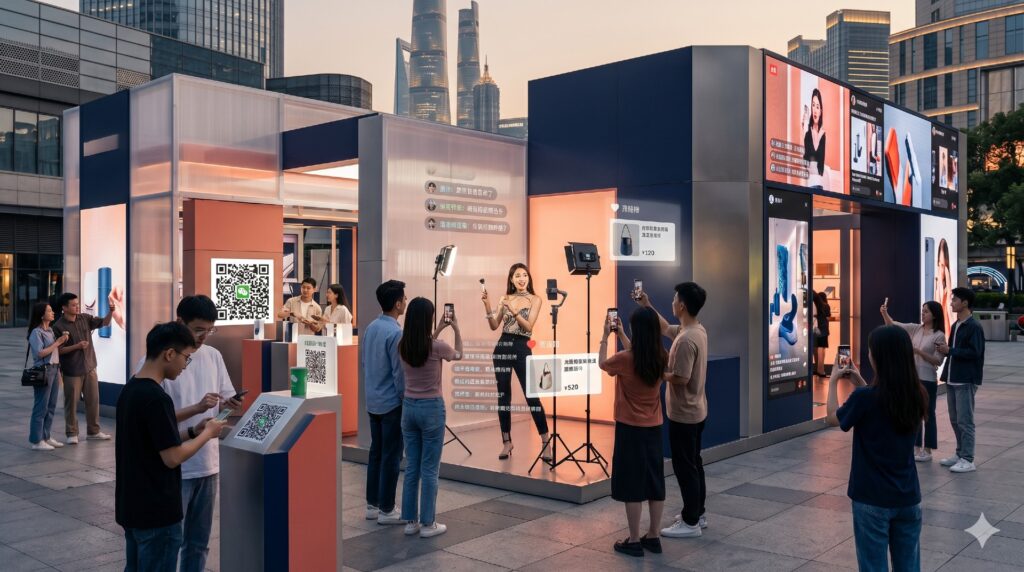
In China, the strongest pop-up experiences are not just temporary physical spaces. They are integrated consumer journeys. They connect social discovery, creator validation, reservation systems, QR-code participation, livestreaming, mobile payment, membership capture, limited-edition commerce, and post-event retargeting. The pop-up is not the end point. It is a node in a larger social commerce ecosystem.
That distinction matters for U.S. brands.
The lesson from China is not simply that pop-ups should be more photogenic, more digital, or more technologically impressive. The deeper lesson is that the pop-up can become a full-funnel experience: a way to generate content, test cultural relevance, drive transaction, capture first-party data, and build community at the same time.
For brands navigating a fragmented U.S. media and retail environment, this is an important strategic signal.
China’s Advantage Is Ecosystem-based
China’s strength in pop-up experience is not only about design quality. It is about infrastructure.
Chinese consumers are operating inside one of the world’s most mature social commerce environments. Social discovery, shopping, entertainment, payment, creator influence, messaging, membership, and customer service are more tightly connected than they are in most Western markets. Platforms such as Douyin, Xiaohongshu, WeChat, Tmall, JD.com, and Meituan have conditioned consumers to move fluidly between inspiration, validation, transaction, and fulfillment.
Recent 2026 market data helps explain why this matters. China’s social commerce market is projected to exceed four trillion U.S. dollars in 2026. China has more than 1.12 billion internet users, and online audiovisual platforms have reached more than 1.09 billion users. Short video, livestreaming, mobile payment, digital membership, and platform-native commerce are not niche behaviors. They are mass behaviors.
That gives Chinese pop-ups a different foundation.
In the U.S., a pop-up often has to work hard to pull consumers from one environment into another: from Instagram to Eventbrite, from TikTok to a website, from a retail visit to an email signup, from a physical interaction to a later purchase. Each handoff can create friction.
In China, the handoffs are often more seamless. A consumer can discover an event through short video, validate it through Xiaohongshu posts, reserve through a mini program, enter with a QR code, participate in a game, pay through a mobile wallet, join a membership program, share content, and continue receiving brand communications afterward.
The experience is designed as a loop, not a moment.
The Best Chinese Pop-Ups Are Built to Travel Digitally
A strong pop-up in China is not only designed for the people who attend. It is designed for the people who will see the event through their feeds.
This changes the creative brief. The space must work as a physical environment, but it must also work as short-form video, peer recommendation, lifestyle content, social proof, and searchable inspiration. The event becomes a content engine.
That is why Chinese pop-ups often include layers such as immersive scenography, limited-edition products, creator previews, KOC seeding, branded rituals, interactive games, collectible rewards, livestream integrations, and highly visual moments designed for sharing. These elements are not decorative. They are mechanisms for distribution.
In a market where online audiovisual behavior reaches more than one billion users, the event’s digital afterlife may be as important as the event itself.
This is an important shift for U.S. marketers. Many U.S. pop-ups are still planned as events first and content second. China suggests the reverse may be more powerful: design the event from the beginning as a media object that consumers, creators, and platforms can circulate.
Pop-ups Are Becoming Social Commerce Theaters
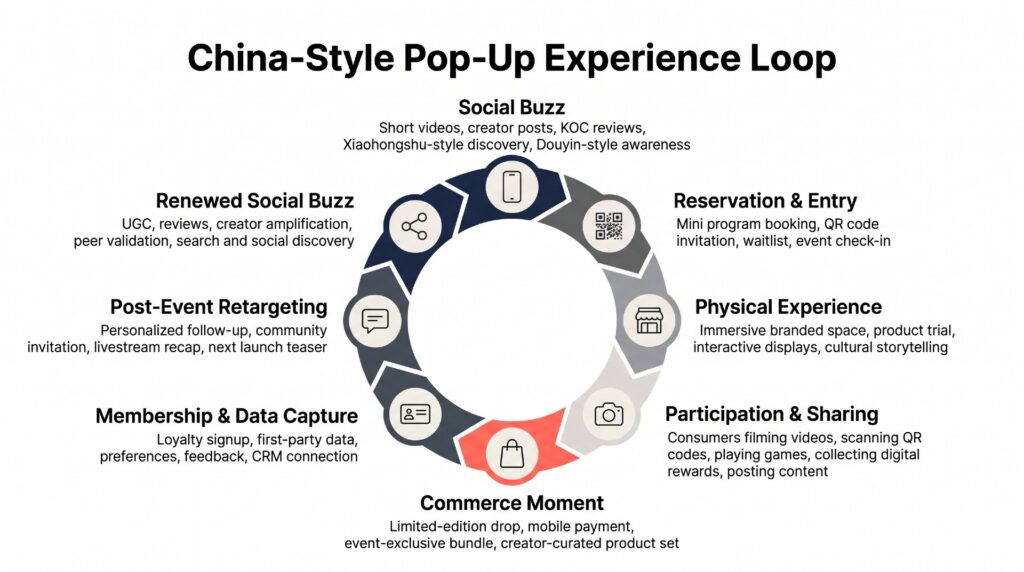
The most useful way to understand China’s pop-up evolution is to see it as “social commerce theater.”
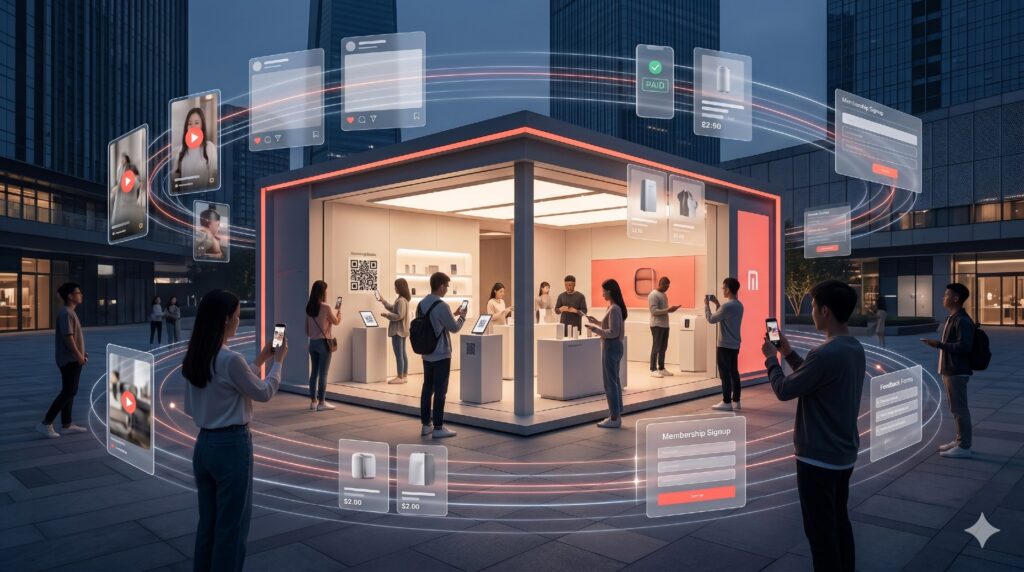
The theater is the immersive physical environment. The commerce is the transaction, product trial, limited drop, or membership conversion. The social layer is the creator ecosystem, peer validation, short video sharing, and platform amplification. The data layer is the QR code, mini program, reservation, purchase behavior, content engagement, and CRM follow-up.
This makes the pop-up more strategically useful than a standard experiential activation.
A well-designed China-style pop-up can answer multiple business questions:
- Which audiences are most motivated to attend?
- Which product stories generate the most sharing?
- Which cultural cues feel authentic versus forced?
- Which creators drive real-world participation, not just views?
- Which offers convert interest into purchase?
- Which consumer segments are willing to join a membership or community?
- Which experience moments create the strongest post-event advocacy?
In this model, the pop-up becomes a live research environment as much as a brand experience. It allows brands to observe behavior, capture language, test engagement mechanics, and measure how culture, content, and commerce interact in real time.
Culture Is the Multiplier
China’s pop-up excellence is not only technological. It is cultural.
The most successful experiences often tap into fandom, local identity, seasonal rituals, food culture, beauty routines, gaming, entertainment, nostalgia, wellness, street style, or youth subcultures. They give consumers a reason to participate beyond the product itself.
This is where many U.S. brands can learn the most.
In an attention-saturated environment, consumers do not share a brand experience simply because it exists. They share it when it helps them express taste, identity, belonging, discovery, expertise, humor, aspiration, or cultural fluency.
A pop-up that is merely “Instagrammable” may generate surface-level content. A pop-up that taps into cultural meaning can generate emotional participation.
For multicultural and youth audiences in the U.S., this distinction is especially important. Gen Z and Gen Alpha consumers are fluent in brand signals. They can quickly detect when a cultural reference feels borrowed rather than understood. Asian American consumers, in particular, may respond differently to Asian-inspired aesthetics, flavors, collaborations, and entertainment cues depending on whether the execution feels specific, respectful, and credible.
The lesson is not to add cultural symbols to an experience. The lesson is to understand the cultural system behind the symbols.
What U.S. Brands Should Take From China
The U.S. cannot copy China’s pop-up model directly. The platform environment is more fragmented. There is no single WeChat equivalent that integrates messaging, payment, mini programs, CRM, reservations, and social sharing at national scale. U.S. consumers move across TikTok, Instagram, YouTube, Google, Amazon, retailer apps, brand websites, SMS, email, and physical stores.
But the strategic principles are highly transferable.
First, U.S. brands should design pop-ups as journeys, not destinations.
The work should begin before the physical event. Brands should identify the audience segments most likely to care, the creators who can credibly seed anticipation, the language consumers use to describe the category, and the cultural tensions the experience can tap into. The event should not simply announce itself. It should build momentum.
Second, the physical experience should be participatory.
Consumers should not only observe the brand world. They should do something: customize, taste, test, vote, collect, play, scan, co-create, learn, compare, or unlock. Participation creates memory. It also creates data.
Third, the experience should be designed for shareability with substance.
Photo moments matter, but they are not enough. The strongest experiences give people something worth saying. A good pop-up creates stories, not just images.
Fourth, commerce should be embedded naturally.
The purchase opportunity should feel connected to the experience, not bolted on afterward. Limited drops, personalized recommendations, event-exclusive bundles, creator-curated edits, or post-event offers can help move consumers from interest to action.
Fifth, the post-event strategy should be planned from the beginning.
Too many pop-ups end when the lease ends. A stronger model treats the event as the beginning of a longer relationship. Attendees can be invited into communities, research panels, loyalty programs, product feedback loops, creator content streams, and future launch moments.
The Implications for U.S. Experiential Strategy
China’s pop-up model suggests that experiential retail is moving from spectacle to system.
The old question was: “How do we create a memorable event?”
The new question is: “How do we create an experience that moves through the full consumer journey?”
That means U.S. brands need to evaluate pop-ups across a broader set of criteria:
- Does the experience generate social discovery before consumers arrive?
- Does it create culturally meaningful participation once they are there?
- Does it produce content that travels beyond the attendees?
- Does it connect naturally to commerce?
- Does it capture first-party data with a clear value exchange?
- Does it build trust with priority audiences?
- Does it generate insight that can inform future product, messaging, and retail decisions?
The more sophisticated the answers, the more strategic the pop-up becomes.
Why This Matters Now
Several forces make this moment especially relevant for U.S. brands.
Media costs are rising. Digital targeting is more constrained. Consumers are more skeptical of generic advertising. Retailers are building media networks. AI is changing search and discovery. Younger consumers expect brands to show up as experiences, communities, content ecosystems, and cultural participants, not just sellers.
At the same time, physical retail is being reimagined. Stores are no longer only points of sale. They are service hubs, content stages, fulfillment nodes, community spaces, and data-generating environments.
China is further along in connecting these roles.
Its pop-up model shows what happens when physical experience is designed for a world where consumers discover through content, validate through peers, buy through platforms, and expect convenience at every step.
For U.S. brands, the opportunity is not to imitate the surface of Chinese pop-ups. It is to adopt the operating logic.
Sparkle’s Point of View
At Sparkle Insights, we believe China’s pop-up evolution is one of the clearest signals of where experiential marketing is headed.
The strongest pop-ups are no longer temporary stores. They are integrated cultural-commerce systems. They connect emotion and transaction, participation and data, social sharing and consumer insight.
For U.S. brands, especially those trying to engage Gen Z, Gen Alpha, Asian American, multicultural, beauty, fashion, food, entertainment, and lifestyle audiences, the China signal is highly relevant.
A future-ready pop-up should be built around four strategic questions:
- What cultural reason does the consumer have to care?
- What social reason do they have to share?
- What commercial reason do they have to act?
- What relationship reason do they have to stay connected?
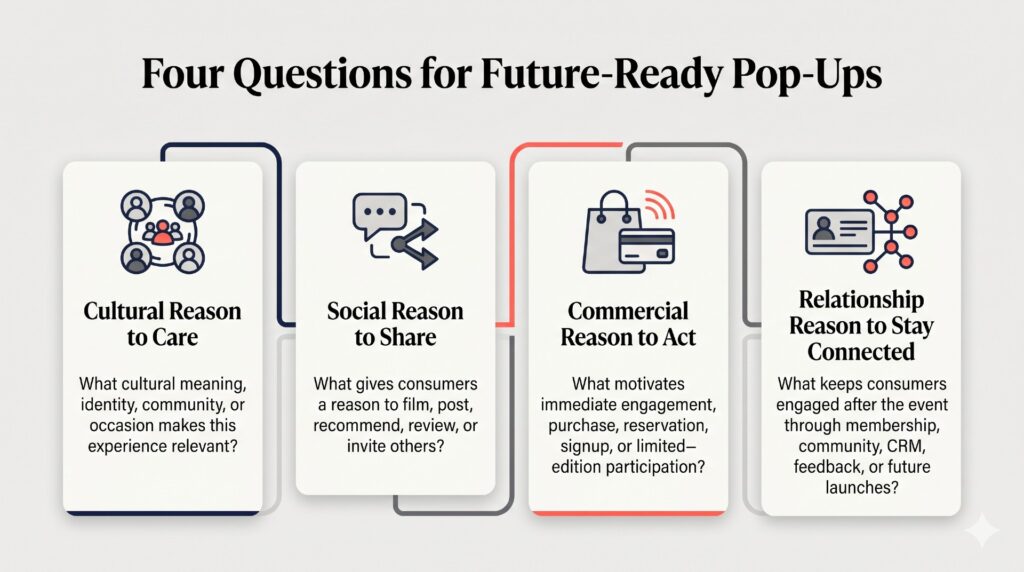
When brands can answer all four, a pop-up becomes more than a moment. It becomes a platform for learning, engagement, and growth.
China has shown that the most powerful experiential retail is not just immersive. It is connected. It is participatory. It is measurable. And above all, it is culturally alive.
That is the opportunity for U.S. brands now.