At the recent 3AF May conference in LA, a conversation with Liangrui “Renee” Zhao of TikTok Global Client Solutions sparked an important question: What does brand building mean when culture, creators, media, and commerce are collapsing into the same consumer moment?
Renee described the emerging connection between TikTok and Amazon in a simple but powerful way: TikTok drives culture-led discovery through creators and communities, while Amazon helps capture purchase intent closer to the point of decision.
That framing points to a much larger shift in marketing.
For decades, brands have organized their thinking around a funnel: awareness, consideration, intent, purchase, loyalty. But platforms like TikTok are reshaping that journey. A consumer can be entertained, influenced, educated, reassured, and converted within the span of a short video. The path from “I’ve never heard of this” to “I want this now” is becoming shorter, more emotional, more social, and more culturally mediated.
TikTok announced in 2024 that users could discover and purchase select Amazon products directly within the TikTok app, with the shopping experience powered by Amazon through ads placed on TikTok. Users who link their Amazon and TikTok accounts can see real-time pricing, Prime eligibility, delivery estimates, and product details on select Amazon product ads. TikTok also supports Amazon Buy with Prime and Multi-Channel Fulfillment integrations for eligible merchants, allowing Prime branding and delivery promises to appear in TikTok ads.
These may sound like technical integrations, but strategically, they represent something much bigger: the continued merging of media, marketplace, and culture.
The Funnel Has Compressed
The traditional marketing funnel assumed that brand building happened upstream and conversion happened downstream. A campaign created awareness. A website or retail shelf supported consideration. Promotions and retail media pushed conversion.
That separation is less useful today.
On TikTok, brand discovery often happens through entertainment, not advertising in the conventional sense. A product may enter the consumer’s mind through a creator’s routine, a funny cultural observation, a “things I wish I knew earlier” video, a food hack, a beauty transformation, a family story, or a moment of peer validation.
The consumer may not think, “I am watching an ad.” They may think, “That’s useful,” “That’s funny,” “That feels like me,” “I trust this creator,” or “I need to send this to my sister.”
Then, almost instantly, the same environment can make purchase frictionless.
This changes the meaning of brand building. Brand building is no longer only about creating long-term awareness before a later transaction. Increasingly, brand building is about creating meaning at the moment of discovery.
The brand has to answer several questions almost simultaneously:
- Why should I pay attention?
- Why does this feel relevant to my life?
- Why do I trust the person showing it to me?
- Why does this product belong in my world?
- Why should I act now?
When the distance between discovery and purchase shrinks, the emotional and cultural work of branding becomes more important, not less.
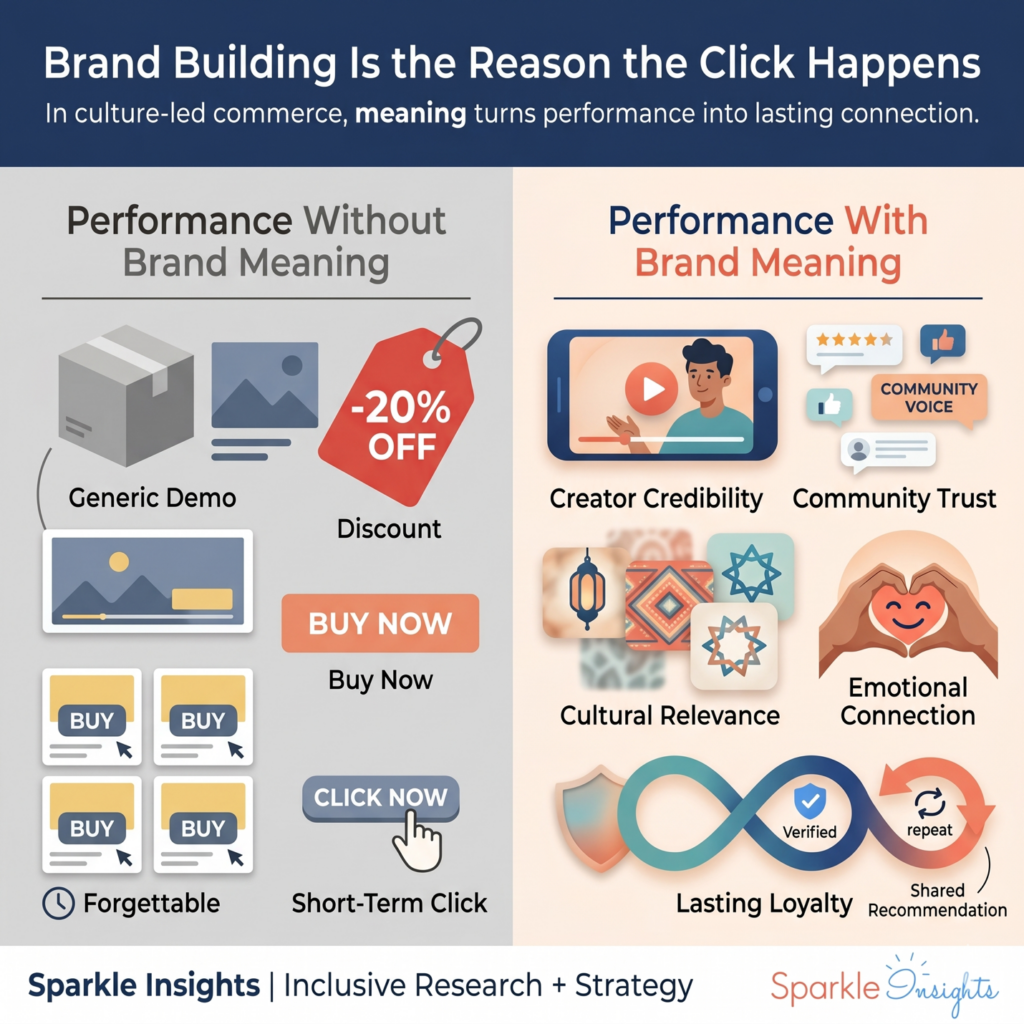
Brand Building Is the Reason the Click Happens
In a commerce-driven environment, there is a temptation to treat creativity as merely a conversion tool. The logic is understandable: if platforms can measure clicks, checkouts, and sales more directly, marketers may prioritize what can be optimized quickly.
But performance without brand meaning can become interchangeable. One product demo looks like another. One discount message sounds like another. One creator brief follows the same formula as the next.
In this environment, brand building is what gives performance marketing its unfair advantage.
It is the difference between a viewer thinking. Consumers are increasingly deciding between brands that feel “cheap” and brands that feel like they truly understand them.
It is the difference between impulse buying and brand affinity. It is the difference between a one-time transaction and a product that becomes part of a consumer’s routine, identity, or recommendation network.
Brand building now lives inside the scroll. It lives in the creator choice, the opening hook, the cultural reference, the product ritual, the comment section, the Amazon product page, the delivery promise, and the review ecosystem. It is not a separate layer added after the media buy. It is the connective tissue between culture and commerce.
Culture-Led Discovery Is Multicultural by Nature
One reason this shift matters so much is that platforms like TikTok make culture visible in a way traditional media often did not.
Culture is no longer something brands can treat as a “segment” or a “campaign theme.” It is the environment in which discovery happens.
Consumers today move fluidly across identities, languages, communities, geographies, fandoms, and interests. A beauty trend may start in Korea, be adapted by creators in Los Angeles, translated by bilingual creators in Mexico City, and purchased by consumers through Amazon. A food product may gain momentum because it connects with immigrant nostalgia, wellness culture, convenience, and creator-led experimentation. A financial product may resonate differently depending on generation, family structure, migration history, and cultural attitudes toward money.
This is the new multicultural reality.
Multicultural marketing is not only about reaching racial or ethnic groups within the U.S. It is about understanding how culture travels, how communities influence each other, and how consumers interpret brands through the lens of identity, belonging, language, aspiration, family, and lived experience.
For brands, the opportunity is not simply to “target diverse consumers.” The opportunity is to understand how culture shapes desire, trust, and action.
That requires asking better questions:
- What community behavior are we entering?
- What cultural truth gives this product relevance?
- Who has permission to tell this story?
- What language, humor, values, or rituals matter?
- How does this audience define authenticity?
- How does influence travel across borders, generations, and communities?
- What makes a product worth sharing, not just buying?
In a TikTok–Amazon environment, cultural fluency becomes a business advantage.
Cross-Border Influence Is Becoming Harder to Separate From Domestic Marketing
The TikTok–Amazon model also highlights how increasingly global consumer influence has become.
A consumer in the U.S. may be influenced by a creator in Asia. A Latin American beauty trend may influence U.S. Gen Z shoppers. A food product may move from immigrant households into mainstream retail. A gaming, anime, fashion, or skincare trend may travel across markets before a brand’s official campaign catches up.
For global and cross-border brands, this creates both opportunity and complexity.
The same product may carry different meanings in different markets. A claim that works in one country may not resonate in another. A creator who feels aspirational in one cultural context may feel irrelevant or inauthentic in another. A product benefit that is functional in one market may be emotional in another.
The new challenge is not just localization. It is cultural translation.
Brands need to understand how ideas move across markets, how cultural references change meaning, and how commerce platforms shape trust differently depending on audience context.
This is where inclusive research and strategy become essential. Brands need insight into not only who is buying, but why the product matters, how it is being discovered, and what cultural meaning is attached to it.
The Amazon Side Matters Too
TikTok may create the spark, but Amazon often provides reassurance.
Amazon has built consumer expectations around convenience, product comparison, reviews, delivery speed, and checkout familiarity. When Amazon details, Prime eligibility, delivery estimates, or Buy with Prime signals appear in or alongside social ads, they can reduce hesitation at a critical moment.
This matters because culture creates interest, but commerce infrastructure can reduce risk.
A consumer may discover a product through TikTok, but still want to know:
- Is it available now?
- Can I trust the seller?
- What do reviews say?
- Will it arrive quickly?
- Can I return it?
- Is the price reasonable?
The most successful brands will not treat TikTok and Amazon as separate silos. They will think about the full discovery-to-purchase experience. The TikTok creative, creator content, product detail page, reviews, pricing, delivery promise, and post-purchase experience all contribute to the brand impression.
In other words, the storefront is no longer just the Amazon page.
The storefront begins with the video.
Role of Creative Agencies
The rise of platform-driven commerce does not make creative agencies less important. It changes what they must become.
Creative agencies can no longer focus only on polished campaign assets. They need to help brands build systems that connect cultural insight, creator strategy, commerce behavior, and measurable outcomes.
Agencies must become interpreters of culture. The first question is not, “What ad should we make?” but rather, “What cultural context are we entering?” Agencies need to help brands understand community behaviors, creator codes, humor, language, visual style, category rituals, and cultural sensitivities. This is especially important for inclusive and multicultural marketing, where surface-level representation can easily feel forced, tokenistic, or disconnected from lived experience. The creative idea must emerge from real audience understanding.
Agencies must design creator ecosystems. The influencer list is not the strategy. Brands need different types of creator roles: cultural translators, product educators, entertainers, niche experts, community insiders, everyday users, and trusted reviewers. A beauty brand, food brand, financial services company, entertainment platform, technology brand, or household product may need very different creator mixes depending on the audience, category, and market. The agency’s role is to design the ecosystem: who speaks, what they are allowed to make, what must remain consistent, and where authenticity should not be over-controlled.
Agencies must build commerce-native storytelling. A TikTok ad connected to Amazon cannot feel like a TV spot cut down to vertical video. It has to behave like content native to the platform. The product benefit should be embedded in a story, ritual, tension, or moment of usefulness. The best social commerce creative does not interrupt culture; it participates in it.
Examples include:
- A food brand can show up through family shortcuts, cultural memory, ingredient discovery, or “lazy dinner” hacks.
- A beauty brand can show up through skin tone, climate, routine, self-expression, or creator credibility.
- A household product can show up through everyday problem-solving, parenting, humor, or intergenerational family life.
- A financial brand can show up through money values, family responsibility, entrepreneurship, migration stories, or practical advice.
- An entertainment brand can show up through fandom, identity, nostalgia, and shared cultural moments.
The goal is not simply to say “buy now.” The goal is to make buying feel like the natural next step.
Agencies must protect distinctiveness in an optimized world. Platforms reward fast learning. That is good. But optimization can also create sameness. If every brand uses the same hook, same editing style, same creator archetype, same urgency language, and same product-demo structure, performance may improve in the short term while brand identity weakens over time. Creative agencies have an important role to play in protecting brand distinctiveness. Testing should not mean abandoning strategy. The best agencies will test creative hypotheses, not just thumbnails and calls to action.
They will ask:
- Which cultural truth drives stronger engagement?
- Which creator archetype builds more trust?
- Which product ritual is more memorable?
- Which message builds both conversion and brand equity?
- Which audience segment responds emotionally, not just behaviorally?
- Which market requires adaptation, and which idea can travel globally?
Agencies must connect the whole journey. In the TikTok–Amazon environment, brand experience is fragmented but cumulative. A consumer may encounter a brand through a creator video, a paid TikTok ad, an Amazon product detail page, reviews, retargeted ads, unboxing content, and social comments. Each touchpoint may be small, but together they form the brand. Agencies can help ensure those touchpoints reinforce one another. The promise made in the TikTok video should match the product page. The creator story should align with the brand’s positioning. The reviews should reveal language that can feed future creative. The commerce experience should deliver on the emotional expectation set by the content. This is where creative, media, commerce, and research need to work together.
Beyond Clicks to Consumer Motivation
As social commerce becomes more measurable, brands will have more behavioral data. But behavioral data alone cannot explain meaning.
It can tell us what people clicked. It cannot fully tell us why they cared.
That is where research becomes essential.
Brands need to understand:
- What makes a creator credible?
- What cultural cues make a brand feel authentic?
- What causes skepticism?
- What role do comments and reviews play in trust?
- How do different cultural communities interpret the same creative?
- When does convenience drive action, and when does identity drive affinity?
- What makes a purchase feel impulsive versus intentional?
- How does the Amazon environment reinforce or weaken the brand impression created on TikTok?
- How does the same idea travel across markets, languages, and generations?
These questions are especially important for brands trying to grow inclusively. The same creative execution may land very differently across communities. A message that feels playful to one audience may feel irrelevant to another. A creator who resonates with one cultural group may not carry the same trust with another. A product benefit that matters in one market may be secondary in another.
The future of brand building will require both data fluency and cultural fluency.
A New Definition of Brand Building
In this new environment, brand building is not separate from commerce. It is not the opposite of performance. It is the reason performance can scale without becoming generic.
Brand building is the work of creating cultural meaning, emotional relevance, and memory in the same moment that a consumer is discovering a product.
TikTok may be where the spark happens. Amazon may be where the purchase happens. But the brand is built in the bridge between the two.
That bridge is made of culture, creators, trust, community, convenience, and experience.
For marketers, the challenge is not simply to shorten the path to purchase. The challenge is to make that path meaningful.
For creative agencies, the opportunity is not simply to produce more content. It is to become a strategic partner in culture-led commerce.
And for brands seeking inclusive growth, the mandate is clear: understand the communities and markets you want to reach, respect the cultural contexts where discovery happens, and build creative systems that do more than convert.
Build systems that make people feel seen, understood, and motivated to act.
Because in the TikTok–Amazon era, the future of brand building will belong to brands that can turn discovery into desire and desire into lasting connection.