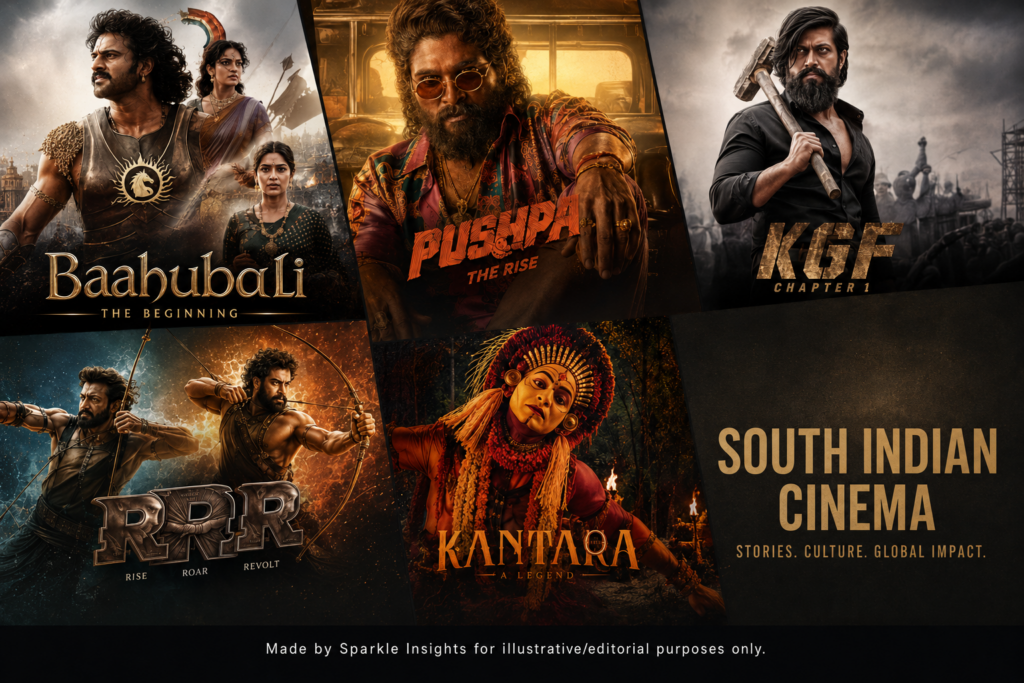
For decades, many American marketers have treated “Indian consumers” as a single cultural segment, often relying on Bollywood imagery, Hindi-language assumptions, and broad South Asian representation strategies. The rapid rise of South Indian cinema across global streaming platforms shows how outdated that framework has become.
According to recent reporting citing Ormax Media, South Indian films now dominate OTT acquisition and engagement across Netflix, Prime Video, JioHotstar, and ZEE5. Telugu, Tamil, Kannada, and Malayalam-language films are generating strong completion rates, sustained watch time, and consistent audience demand, not just within India, but across global diaspora audiences.
For American marketers, advertisers, media companies, and theater chains, this is more than an entertainment trend. It is a signal that the future of multicultural marketing will require deeper cultural nuance and more sophisticated audience understanding than many brands currently use.
The Problem With “Bollywood” as a Catch-All
In the U.S., Indian representation has long been flattened into a Bollywood-centric understanding of culture. “Indian culture” is still frequently represented through Hindi-language references, wedding imagery, Bollywood dance aesthetics, and generalized South Asian tropes. India is not culturally unified in the way many Western marketers assume.
It is a multilingual, multiethnic, and multireligious country with enormous regional diversity shaped by language, religion, migration patterns, food cultures, politics, and media ecosystems. South India alone contains multiple major cultural worlds, including Telugu, Tamil, Kannada, and Malayalam-speaking audiences. Each has its own entertainment industries, fandom systems, storytelling traditions, and cultural identities.
Streaming data increasingly shows that audiences do not behave as one unified “Indian” consumer segment.
Streaming Platforms Are Revealing What Marketers Missed
One of the most important dynamics here is that OTT platforms optimize around actual audience behavior rather than broad demographic assumptions. Algorithms reward engagement, repeat viewing, fandom intensity, and retention.
Platforms are learning that deeply regional content often performs exceptionally well.
This matters because many multicultural marketing strategies in the U.S. still rely on broad census-style segmentation. “Asian Indian” is often treated as a single affluent, English-speaking category. Media consumption reveals much more internal fragmentation than many brands recognize.
A Telugu-speaking engineer in Dallas may have entirely different entertainment habits, creators, cultural references, and community touchpoints than a Punjabi Sikh family in New Jersey or a Tamil household in Silicon Valley. Streaming platforms are effectively showing marketers that cultural specificity, not generalized identity, is increasingly driving engagement.
English Fluency Is Masking Cultural Complexity
One reason many brands underestimate this diversity is because Indian Americans are overwhelmingly English-fluent, particularly compared to some other immigrant populations. Language fluency does not equal cultural sameness.
Many Indian Americans operate professionally in English while maintaining strong emotional connections to regional-language entertainment, religion, creators, food traditions, festivals, and online communities. Streaming platforms and YouTube have made it easier than ever for diaspora audiences to stay connected to regional identity across generations.
That creates an important blind spot for marketers. Brands often assume that if an audience is English-speaking, one multicultural campaign will resonate broadly. Streaming behavior suggests otherwise.
In reality, English-language targeting may conceal highly differentiated cultural ecosystems underneath.
South Indian Cinema Reflects a Larger Media Shift
The rise of South Indian cinema is also part of a broader transformation in how audiences discover and value content. Streaming has made it easier for regional-language films to reach viewers who were previously underserved by mainstream distribution.
Films like Baahubali, Pushpa, KGF, RRR, and Kantara did not become major successes because they diluted regional identity. They succeeded because they embraced it. Their storytelling, emotional intensity, mythology, and cultural rootedness felt distinctive rather than generalized for mass appeal.
That has important implications for marketers. The old media model assumed broad appeal required broad cultural messaging. Increasingly, the opposite may be true: culturally specific storytelling can travel further because it feels more authentic.
Why This Matters Beyond Entertainment
South Indian cinema’s success also reveals changing emotional preferences among audiences. Many South Indian films lean heavily into regional pride, spirituality, emotional sincerity, family structures, and mythological symbolism. By contrast, much of mainstream Bollywood over the past two decades became increasingly urban, cosmopolitan, and globally aspirational.
The strong audience response to South Indian storytelling may signal broader consumer appetite for content that feels emotionally grounded rather than globally polished.
That has implications far beyond entertainment. Consumers increasingly reward brands, creators, and media that feel culturally rooted and emotionally authentic instead of broadly optimized for everyone.
American Brands and Theaters May Still Be Undershooting the Opportunity
U.S. theater chains have already seen evidence of this shift. South Indian films routinely generate strong turnout in diaspora-heavy markets and often create highly communal viewing experiences with opening-night celebrations, group attendance, and intense fandom loyalty.
Many exhibitors and advertisers still approach Indian audiences as a single niche category rather than recognizing the differences between Tamil, Telugu, Hindi, Malayalam, Punjabi, Gujarati, Bengali, and other consumer ecosystems.
That likely leaves significant engagement opportunities untapped.
The brands that succeed in the next phase of multicultural marketing will likely move beyond broad representation alone and invest in deeper cultural intelligence. They will need to understand not just ethnicity, but intra-community nuance, media ecosystems, emotional drivers, language, religion, region, and identity layers.
What Marketers and Advertisers Should Do Next
Brands do not need to create separate campaigns for every Indian subcommunity. They do need to move beyond overly broad assumptions about what “Indian consumers” want, watch, and identify with.
The first step is recognizing that language, region, religion, and cultural identity can shape media behavior far more than many marketers currently account for. A one-size-fits-all “South Asian” campaign may achieve visibility while still missing cultural relevance.
Streaming behavior also suggests that marketers should pay closer attention to regional entertainment ecosystems and creator networks. Bollywood is no longer the sole gateway into Indian culture, particularly for younger and more digitally connected audiences. Tamil, Telugu, Malayalam, Punjabi, and other regional media ecosystems increasingly influence identity, fandom, and consumer discovery.
Brands should also rethink how they define multicultural targeting. English fluency should not be treated as evidence of cultural uniformity. Many Indian Americans move fluidly between English-speaking professional environments and deeply regional cultural experiences shaped by family, language, religion, entertainment, and community.
That creates opportunities for more nuanced engagement through regional creators, culturally informed partnerships, diaspora community activations, and media strategies that reflect how audiences actually consume content.
Entertainment companies and theater chains may have an especially large opportunity. South Indian film fandom often functions as a highly communal experience driven by loyalty, celebration, and repeat engagement. Exhibitors that better understand those dynamics may be able to build stronger local partnerships and more effective audience development strategies.
The brands that succeed will likely be the ones that understand not just who audiences are, but how identity, language, media behavior, and community intersect.
The Bigger Shift: Multicultural Marketing Is Entering Its Post-Monolith Era
The broader lesson is that multicultural marketing is moving from representation alone toward deeper cultural intelligence.
For years, many brands focused on visibility and inclusion at the broad demographic level. That still matters, but it is no longer enough. Streaming behavior shows that audiences are shaped by layered identities, regional ties, language, religion, fandom, and community.
The rise of South Indian streaming dominance is evidence that cultural specificity can be commercially powerful at scale.
Marketers who understand that shift early will be better positioned to build relevance with audiences who expect to be seen with more precision.