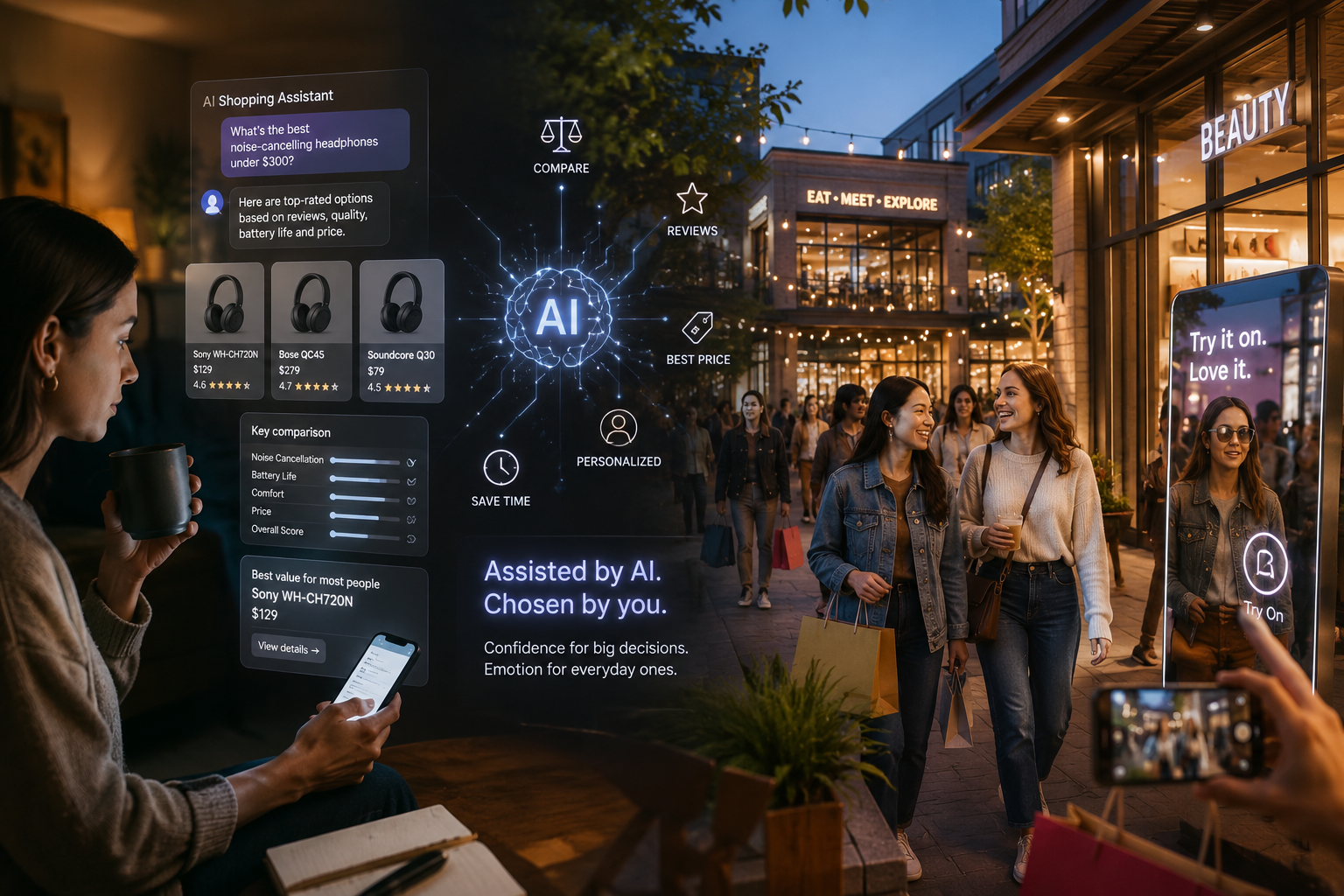
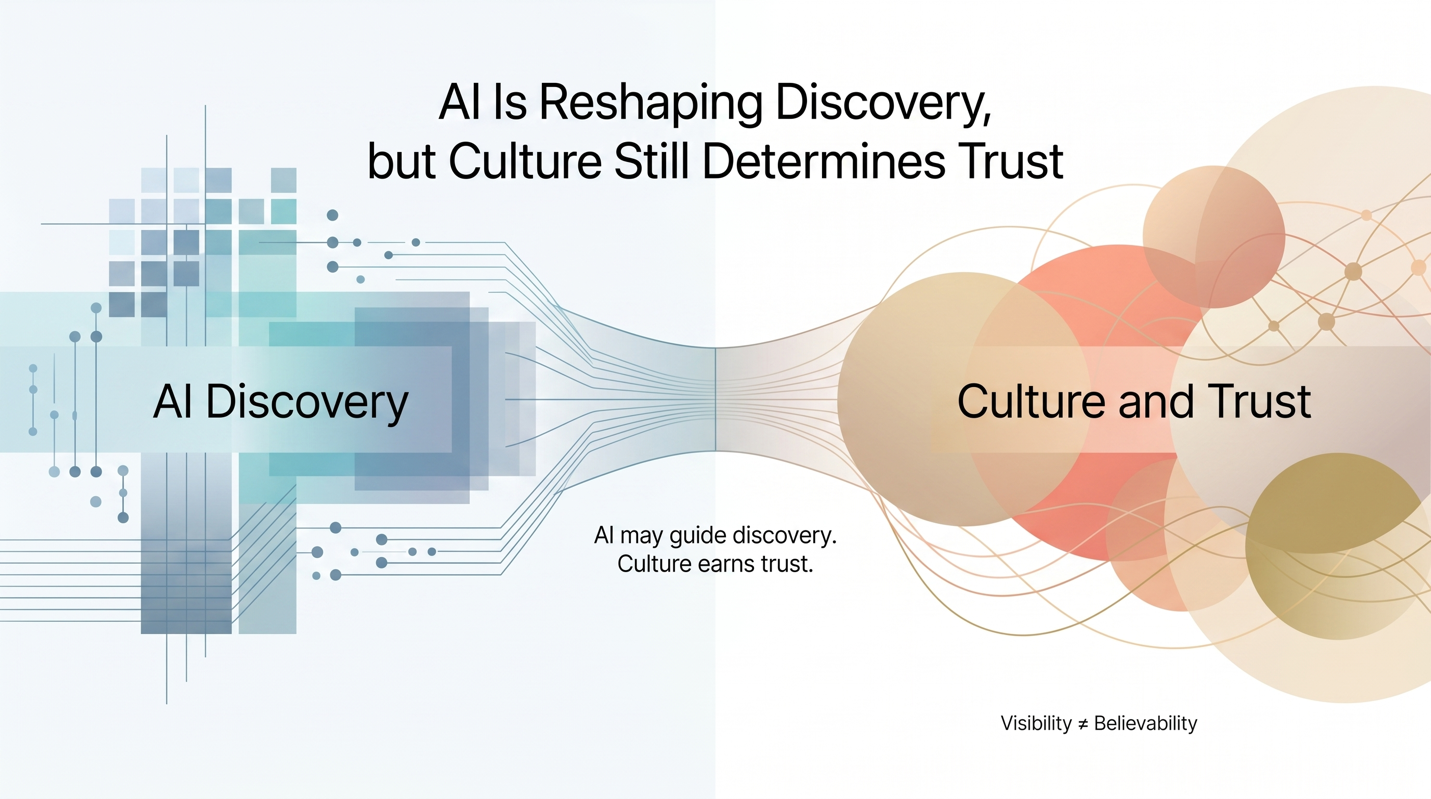
AI is quickly becoming part of how people discover, compare, choose, and buy. Search is shifting from typed keywords to AI-generated answers. Retailers are experimenting with AI assistants, personalized product recommendations, predictive offers, automated creative, dynamic pricing, and agentic commerce. Marketing teams are under pressure to move faster, produce more, personalize more, and automate more.
But speed is not the real competitive advantage. In the AI-commerce era, the winning brands will not be the ones that automate fastest. They will be the ones that understand trust fastest.
That distinction matters because AI is not just changing the mechanics of commerce. It is changing the emotional conditions of decision-making.
Consumers are open to AI help, but they are not blindly surrendering judgment. Adobe reported that among shoppers using AI for online shopping, many are satisfied with AI-generated links and say AI assistance increases purchase confidence. At the same time, Deloitte’s 2025 Connected Consumer research found that consumers want innovation alongside transparency, control, and data security. (Adobe Business)
That is the tension brands now have to solve: consumers want convenience, but they also want confidence.
AI is Making Commerce Easier, But Not Automatically More Trusted
For brands, the promise of AI-commerce is compelling. AI can reduce friction, personalize recommendations, generate creative, optimize media, guide customer service, and shorten the path from discovery to purchase.
But from the consumer’s point of view, the same experience can feel very different.
- A personalized recommendation can feel helpful — or invasive.
- An AI chatbot can feel efficient — or evasive.
- An automated offer can feel relevant — or manipulative.
- An AI-generated product answer can feel convenient — or unverified.
- An AI-created campaign can feel innovative — or inauthentic.
The difference is trust.
Recent commerce research points to this growing trust gap. IBM and NRF’s 2026 research on agentic commerce argues that AI agents will need to navigate nuanced consumer decisions across price, quality, and trusted brands, especially as shoppers become more strategic under economic pressure. Capgemini’s 2026 consumer research similarly emphasizes that value is no longer defined by price alone; quality, trust, and emotional connection also matter. (National Retail Federation)
In other words, automation may help consumers move faster. But trust helps them move forward.
The New Consumer Question: “Can I Believe This?”
In traditional e-commerce, brands competed around assortment, price, convenience, reviews, delivery, and brand familiarity. Those still matter. But AI adds a new layer of uncertainty.
Consumers are now asking, sometimes consciously and sometimes intuitively:
- Can I trust this recommendation?
- Why is this product being shown to me?
- Is this answer complete or biased?
- Is this review real?
- Is this creator authentic?
- Is this price fair?
- Is this brand using my data responsibly?
- Is a human still accountable if something goes wrong?
This is especially important because AI is increasingly entering moments that used to feel personal: beauty routines, health choices, financial decisions, parenting, travel planning, home purchases, education, and identity-driven shopping.
A Vogue Business consumer survey published in April 2026 found that while many consumers use AI chatbots at least occasionally, adoption for fashion and beauty shopping remains limited, with trust and authenticity concerns still prominent. The same research found that consumers continue to value human curation and creativity, especially in categories where taste, identity, and aspiration matter. (Vogue)
That finding has broader implications beyond fashion. The more emotionally loaded the category, the more consumers need more than an answer. They need reassurance.
When Automation Meets Human Judgment
The danger for brands is assuming that because AI can personalize, consumers will automatically feel understood.
But personalization is not the same as understanding.
Personalization says, “We know what you clicked.”
Understanding says, “We know what matters to you.”
That difference becomes critical in multicultural, Gen Z, and Gen Alpha parent contexts — areas where identity, language, culture, family influence, peer validation, and community trust can shape decision-making in ways that simple behavioral data may miss.
For example, a skincare recommendation may technically match a consumer’s browsing history, but miss deeper concerns around skin tone, ingredient safety, cultural beauty standards, creator credibility, or intergenerational advice. A financial product may be algorithmically targeted, but fail to address family obligation, immigrant household dynamics, risk tolerance, or distrust of institutions. A food brand may use AI to generate culturally themed content, but still miss the lived meaning of the cuisine, occasion, or community.
AI can detect patterns. It does not automatically understand context.
That is where brands will either build trust or lose it.
The Trust Advantage Comes From Better Questions
Many brands are asking, “How do we use AI to move faster?”
The better question is, “Where do our consumers need more confidence?”
That shift changes the strategy.
Instead of using AI only to accelerate outputs, brands should use research to understand the trust conditions around AI-enabled commerce:
- Where do consumers welcome automation?
- Where do they want human judgment?
- When does personalization feel useful versus creepy?
- Which claims require proof?
- Which categories require cultural nuance?
- Which audiences are more skeptical, and why?
- What role do creators, reviews, family, friends, experts, and AI tools each play in the decision journey?
- What makes an AI-generated recommendation feel credible?
- What makes it feel generic, biased, or unsafe?
These are not just UX questions. They are brand strategy questions.
What This Means for Marketers
The AI-commerce era will reward brands that design for confidence, not just conversion.
That means being transparent about how AI is used. It means giving consumers control when decisions feel sensitive. It means making product information clear, verifiable, and easy to compare. It means knowing when a human voice matters more than an automated response. It means understanding which audiences need cultural specificity, community validation, or expert reassurance before they buy.
It also means recognizing that trust is not universal. Different consumers trust different sources.
Gen Z may trust creators, peer communities, Reddit threads, TikTok comments, Discord groups, and AI search — but not equally across categories. Parents of Gen Alpha may use AI for convenience, but still rely on pediatricians, teachers, family, and other parents for reassurance. Asian American consumers may navigate trust through family networks, community reputation, ethnic media, mainstream platforms, expert authority, and culturally fluent creators. Multicultural consumers may be especially attuned to whether AI-generated content feels accurate, respectful, and representative.
A one-size-fits-all trust model will not work.
What Brands Should Do Now
First, map the new decision journey. Do not assume the path to purchase still begins with search and ends with a product page. Consumers may now move through TikTok, AI assistants, creator reviews, group chats, marketplaces, Reddit, YouTube, brand sites, and in-store experiences before deciding.
Second, identify trust friction. Look for the moments where consumers hesitate, verify, compare, abandon, or seek human reassurance. These moments are strategic gold.
Third, test AI experiences qualitatively, not just quantitatively. A chatbot may resolve a query, but still leave the consumer feeling dismissed. A recommendation may generate clicks, but still feel generic. A campaign may perform efficiently, but weaken brand meaning.
Fourth, build culturally intelligent AI-commerce strategies. AI outputs are only as good as the assumptions, data, prompts, and frameworks behind them. Brands need human insight to make sure automated experiences reflect real consumer language, identity, values, and context.
Finally, treat trust as a measurable brand asset. Trust should be researched, tracked, and designed into the experience — not treated as a soft afterthought.
How Sparkle Insights Helps Brands Compete on Trust
At Sparkle Insights, we believe the next phase of commerce will require more than automation. It will require deeper human understanding.
We help brands answer the questions AI alone cannot:
- What do consumers need to believe before they buy?
- Where does automation help, and where does it create doubt?
- How do different audiences define credibility?
- Which messages, creators, platforms, and proof points build trust?
- How do cultural identity, generation, family, and community shape decision-making?
- How should brands show up in AI-assisted journeys without losing authenticity?
This is especially important for brands trying to reach Gen Z, Gen Alpha parents, multicultural consumers, Asian American audiences, and digitally native shoppers whose trust is shaped across platforms, communities, creators, and algorithms.
AI can help brands move faster. But research helps brands move wisely.
Sparkle Point of View
The future of commerce will not be won by automation alone.
As AI becomes embedded in search, shopping, service, media, and personalization, consumers will not simply ask, “Is this convenient?” They will ask, “Can I trust this?”
The brands that understand that question fastest will have the advantage.
Because in the AI-commerce era, trust is not a barrier to scale.
Trust is what makes scale sustainable.