By Iris Yim
Note: The article is based on the presentations from the China International Advertising Festival and AdAsia 2025 in Beijing on Oct. 24 – 26, 2025.
It’s hard to escape the conversation about Artificial Intelligence. Every day brings a new headline, a new tool, or a new prediction about the future. It can feel overwhelming, like trying to drink from a firehose. But what if we set aside the futuristic speculation and focused on a simple, practical reality? What if we started thinking of AI not as a replacement for human creativity, but as a new kind of creative partner?
I use AI daily as a brainstorming partner, as assistant analyst to speed up analysis for research findings, as a thought starter for visual design, proposals, articles, business development strategies…the list is long. I see this not as a threat, but as the arrival of the most powerful collaborator we’ve ever had. The key is learning how to brief it.
This article is designed to do just that. It’s based on the learnings from the China International Advertising Festival and AdAsia 2025 in Beijing on Oct. 24-26, 2025. We’ll cut through the noise to show you how AI is being used in real-world advertising and content creation today. The goal is to move from abstract concepts to concrete examples, revealing AI as a tool that can amplify human ingenuity. As Surya Kotha of 4sightAI puts it, humans and AI are not competitors; we are becoming “co-creators.”
Understanding Your New Partner: What is “Creative AI”?
First, it’s important to know that “AI” isn’t one single thing. In the creative world, professionals work with different types of AI, each designed for a specific job. Based on insights from industry leaders at Accenture Song, we can break them down into three main categories.
| AI Type | Core Function | Simple Analogy |
| Traditional AI | Automating repetitive tasks | Your car’s GPS navigator. You tell it the destination, and it calculates the best route based on rules and data. It’s great for optimizing a single, defined task. |
| Generative AI | Creating new and original content | A creative assistant that can write draft ad copy, design visual concepts, or compose a piece of music based on your instructions and examples. |
| Agentic AI | Independently planning and executing multi-step tasks to achieve a goal | Your car’s co-pilot. It can not only navigate but also proactively adjust the music, suggest a stop at your favorite cafe, and remind you to refuel—all with minimal oversight. |
The Most Important Concept: The Power of “Context”
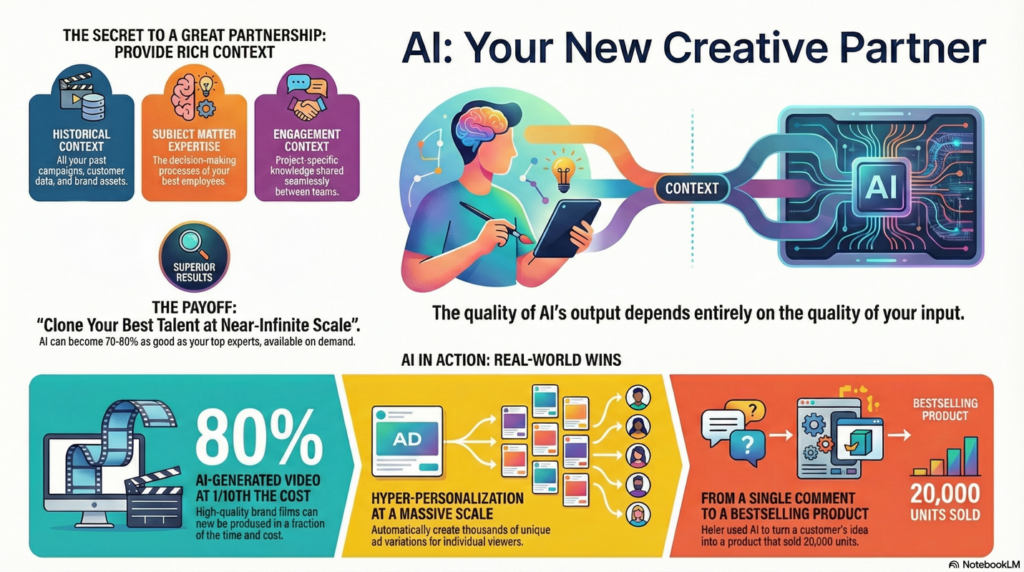
The single most critical factor in working with any AI is context. The quality of an AI’s creative output is directly tied to the quality of the information and background you provide it. And my personal take on it, research, very importantly human research, continues to be a very important foundation of this input.
In simple terms, context is the “personality of your agency or customer” that you feed into the AI model. Without it, AI produces generic results. With rich context, you get fewer iterations and a better, more relevant final product. According to AI strategist Surya Kotha, there are three crucial types of context to build.
- Historical Context: This is the complete record of your past work—all your previous campaigns, customer data, and brand assets. Giving an AI this history allows it to understand what has worked before and maintain brand consistency, leading to much better creative outputs.
- Subject Matter Expertise Context: This involves capturing the unique skills and decision-making processes of your best employees. By tracking how your top designer or strategist interacts with AI tools, the system learns their expert thought process. The strategic payoff is immense: after a couple of months, the “AI will become 70 to 80% as good as that person.” As Kotha notes, “imagine you have a AI solution you have 10,000 of that resources you can do 10,000 jobs at the same time.” This transforms the concept from “capturing skills” to “cloning your best talent at near-infinite scale.”
- Engagement Context: This ensures that project-specific knowledge is passed seamlessly between different departments. By standardizing how information flows from the research team to the scriptwriters to the video producers, you maintain a consistent thread throughout a project, resulting in a cohesive final ad.
Now that we have these foundational concepts, let’s see how they are being put into practice on real creative projects.
AI in Action: From Ad Copy to Virtual Influencers
Creative and advertising agencies are no longer just experimenting with AI; they are integrating it into their daily workflows to produce everything from ad copy and campaign visuals to entirely new forms of brand representation.
Crafting the Message: Teaching AI to Write with Meaning
One of the biggest breakthroughs in creative AI is teaching it not just what to write, but how to think. Dentsu’s “Creative Thinking Model” is a prime example of this. Instead of having their AI copywriter, AICO 2, memorize millions of past headlines, they taught it the thinking process that human copywriters use to arrive at an idea. This is a perfect example of building Subject Matter Expertise Context by embedding the why behind creative choices directly into the AI.
The power of this approach was demonstrated with a headline created by a human for a deeply sensitive campaign about child abuse: “May your unforgettable memory be a happy one.”
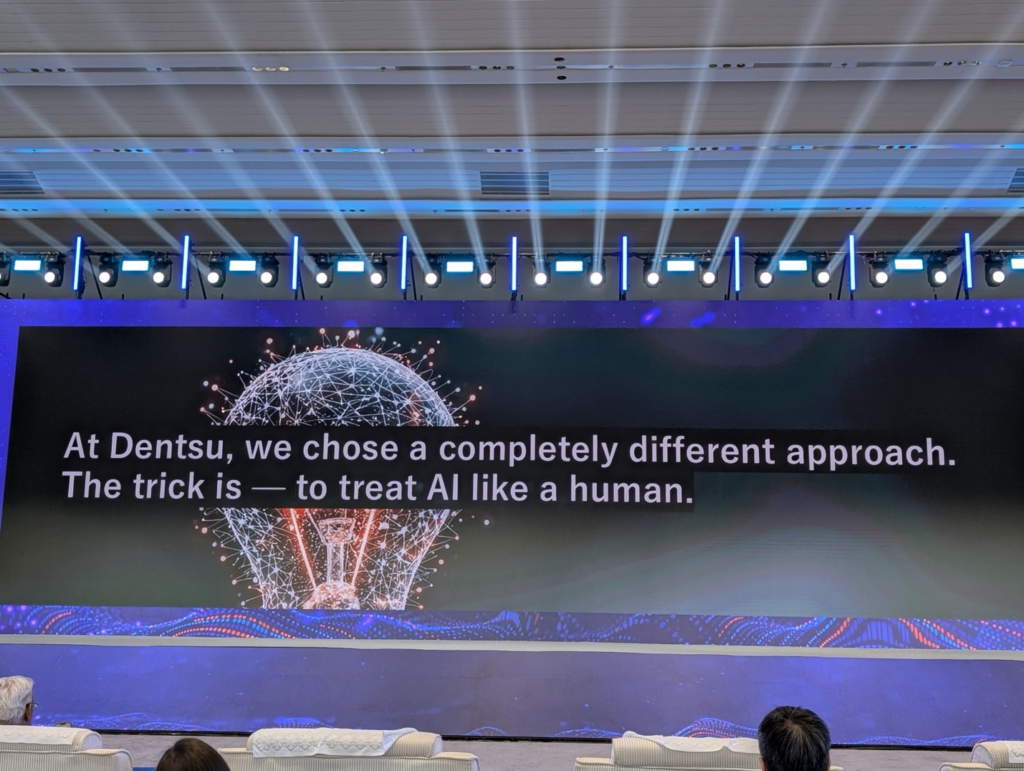
(Source: Human Craft Meets AI: Dentsu’s Creative Thinking Model, Takuma Kawada, Creative Director, CX Creative Center, DENTSU INC., Japan)
The brilliance of this line is its strategic use of paradox. It reframes the word “trauma” as an “unforgettable memory,” a phrase that usually has a positive feeling in Japanese. Dentsu verbalized the strategic thinking behind this choice and fed it to the AI:
- The scene is sensitive, so use gentle words to avoid a gloomy impression.
- Apply the techniques of rephrasing and paradox to create emotional nuance.
By learning the why behind the creative choice—not just the pattern of words—the AI learned to apply creative strategy and nuance, a far more powerful skill than simple memorization.
Creating the Visuals: A Look Inside an AI-Powered Production
AI’s ability to generate video has evolved at a breathtaking pace, moving from simple experiments to full-scale commercial productions.
- Step 1 – Simple Generation: Early capabilities, like those from Baidu, showed the potential to create a short video from just “one image and a line of text.”
- Step 2 – A Real-World Project: In 2023, Ogilvy produced one of the first high-budget, “full AI” videos. The team faced significant early challenges, struggling with generating consistent faces from one scene to the next and finding it difficult for the AI to produce specific human emotions like laughter or sadness. This highlights a key challenge in early generative video: while AI could render a face, it struggled to imbue it with authentic, nuanced human feeling—a task that still required significant human intervention and artistry.
- Step 3 – The Payoff: Just a short time later, the landscape changed dramatically. Ocean Engine shared an example of a high-quality brand film that was 80% AI-generated. The stunning result was produced in a fraction of the time and at “1/10th of the cost” of a traditional video shoot, demonstrating the massive gains in both efficiency and quality.
Personalization at Scale: Making Every Ad Feel Unique
Perhaps AI’s greatest strength is its ability to deliver “hyper-personalization” on a scale that was previously impossible. This means using rich context to create thousands of unique ad variations that feel tailor-made for each individual viewer.
- University Templates: To serve college students, PixelBloom (ai-ppt.com) created 500 unique presentation templates for 500 different universities. They understood that “Peking University students won’t use Tsinghua University templates.” Each template was automatically customized with the correct school emblem and main building by feeding the AI the necessary Historical Context—a task that would have been unthinkably time-consuming to do manually.
- Personalized Video Ads: As explained by Bridge2, a skincare brand can now use generative AI to produce hundreds of ad variations automatically. These ads can feature “different models and product benefits based on the viewer’s age, skin type, and concern.” This relies on Engagement Context, using real-time viewer data to make each message feel directly relevant to the person watching it.
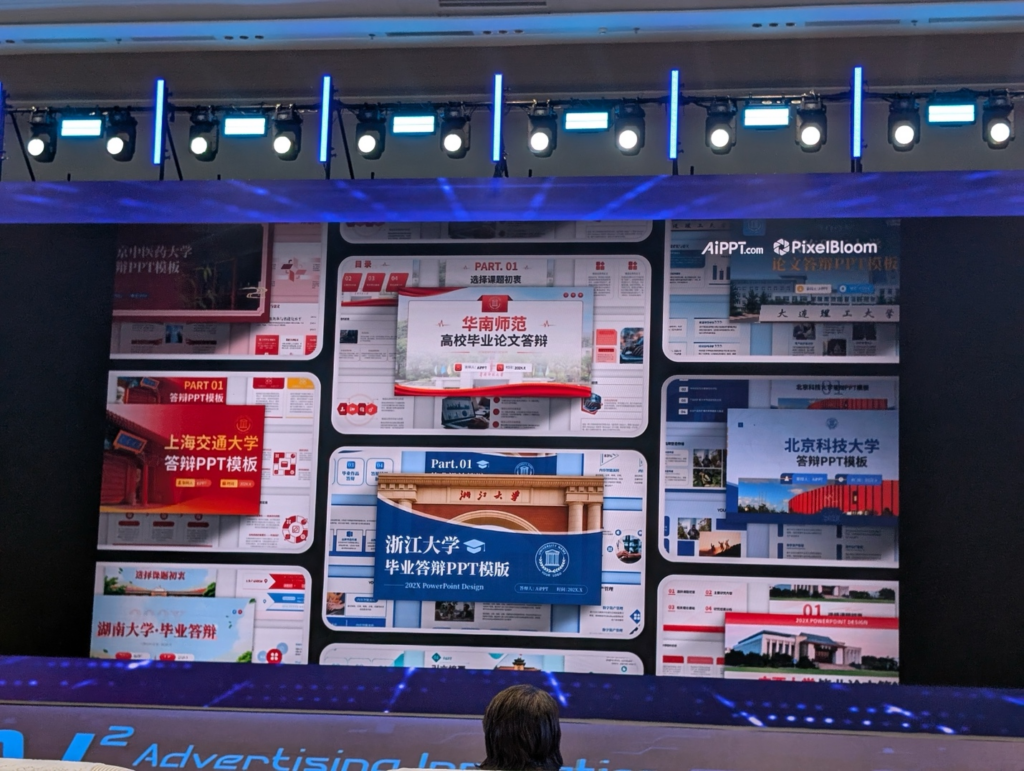
(Source: Survival Code in the AI Era: Explosive Growth Between the Giants, Steven Zhao,Founder & CEO, PixelBloom (AiPPT.com))
The New Talent: AI Avatars and Virtual Influencers
Brands are now creating their own AI-generated ambassadors and virtual influencers. This technology has progressed from a complex, expensive process to a fast and accessible tool.
| Year | Digital Human Capability |
| 2023 | Required filming real models on-location, a costly and time-consuming process. |
| 2025 | Can be generated from a single image and can interact in real-time. |
The primary business advantage is control and reliability. As Aleksei Parfun from the Russian Association of Communication Agencies (RACA) notes, an AI avatar is the ideal brand ambassador because “it never gets tired, never gets sick, has no mood swings, and will never say anything controversial.”
These practical applications show how AI is changing creative work. Next, let’s explore the underlying business strategies that explain why these changes are so important.
The Strategy Behind the Tech: Why Brands are Using AI
Adopting AI isn’t just about using the latest technology; it’s about executing a smarter business strategy. The most effective brands are using AI to solve fundamental marketing challenges, from balancing long-term goals with immediate needs to understanding their customers on a deeper level.
The “Marathon” vs. The “Sprint”
Modern advertising faces a core tension: the need for long-term brand building versus the pressure for short-term sales performance. According to Ed Pank, SVP Lions APAC, the solution is a “twin-pace approach.”
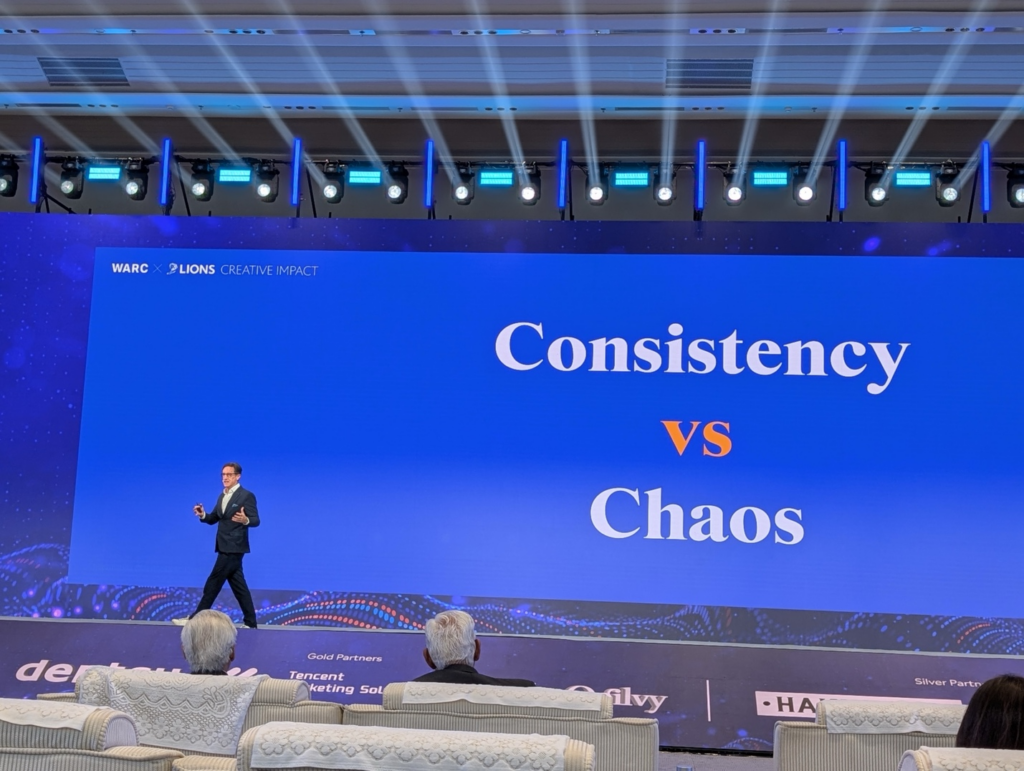
(Source: Creative Impact: Consistency vs Chaos vs Speed, Ed Pank, SVP LIONS, APAC)
Brands need to operate at two speeds simultaneously.
- A “marathon pace” for building brand equity and emotional connection over time.
- A “sprint pace” for driving immediate sales and conversions through performance marketing.
Historically, these two goals were often seen as separate. However, the key insight is that they are deeply connected. Data shows that “even short-term campaigns are supercharged when brand is in the mix.” AI excels at powering the “sprint”—automating the generation of thousands of performance ad variations—which in turn frees up human creatives to focus on the high-concept, emotionally resonant work required for the “marathon.”
From Broadcasting to Listening: AI-Driven Innovation
One of the most transformative uses of AI is its ability to listen to and understand customer conversations at a massive scale, turning public feedback into product innovation. The story of Haier’s “lazy wash” machine is a perfect example of this in action.
- The Insight: It started with a single user comment on the social media platform rednote (Xiaohongshu). A customer asked for a washing machine with separate tubs to wash socks and other clothes at the same time for hygiene and efficiency.
- The Research: Haier’s team saw this comment and used AI-powered tools to research the idea across the web, discovering that many other users shared the same pain point.
- The Innovation: Armed with this data, Haier developed the “three-tub machine,” a direct response to a customer’s idea. The product was an immediate success, selling 20,000 units in just four months.
- The Evolution: The conversation didn’t stop there. Another user later asked for a “four-tub machine” to handle larger items. Haier listened again and developed that product, too.
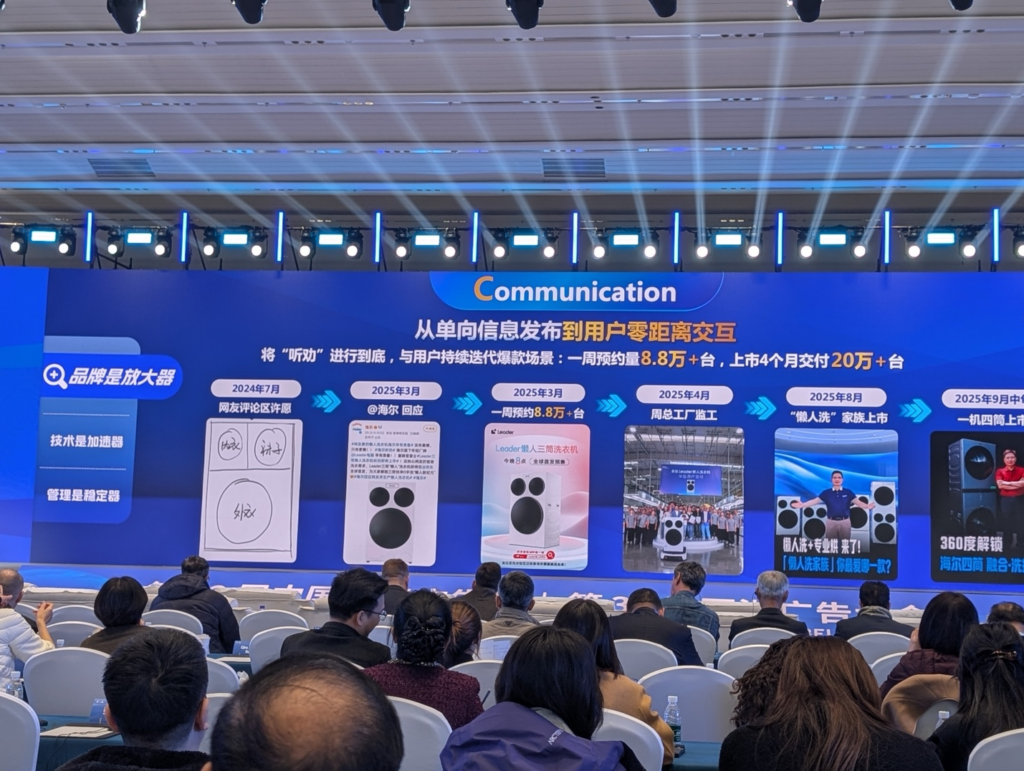
(Source: More Creation, More Possibilities, Wang Meiyan, Chief Brand Officer of Haier Group)
This case illustrates the ultimate strategic shift AI enables: from marketing-led communication (telling customers what they should want) to user-led innovation (building what customers explicitly ask for). Haier didn’t just listen; it used AI-driven social listening to turn a single customer comment into a successful product line. This strategic use of AI builds not just better products, but also deeper loyalty and a stronger brand.
Your Future as a Creative Co-Creator
After seeing these examples, it’s clear that AI is a powerful force in the creative industries. But it is not here to replace human artists, writers, and strategists. On the contrary, as Dentsu points out, the rise of AI makes the “creative direction and judgment of creators even more important.”
AI can generate a hundred options in a minute, but it still requires a human with taste, experience, and a deep understanding of the brand to choose the right one. It can scale an idea to millions of personalized variations, but it can’t come up with the core human insight that makes an idea resonate in the first place.
The future of creative work is a partnership where human insight guides AI’s incredible power. Your role is evolving from creator to creative director of an AI partner. Your value is no longer just in the execution, but in your taste, your strategic vision, and your ability to ask the right questions.