
By Iris Yim
Note: The article is based on the presentations from the China International Advertising Festival and AdAsia 2025 in Beijing on Oct. 24 – 26, 2025.
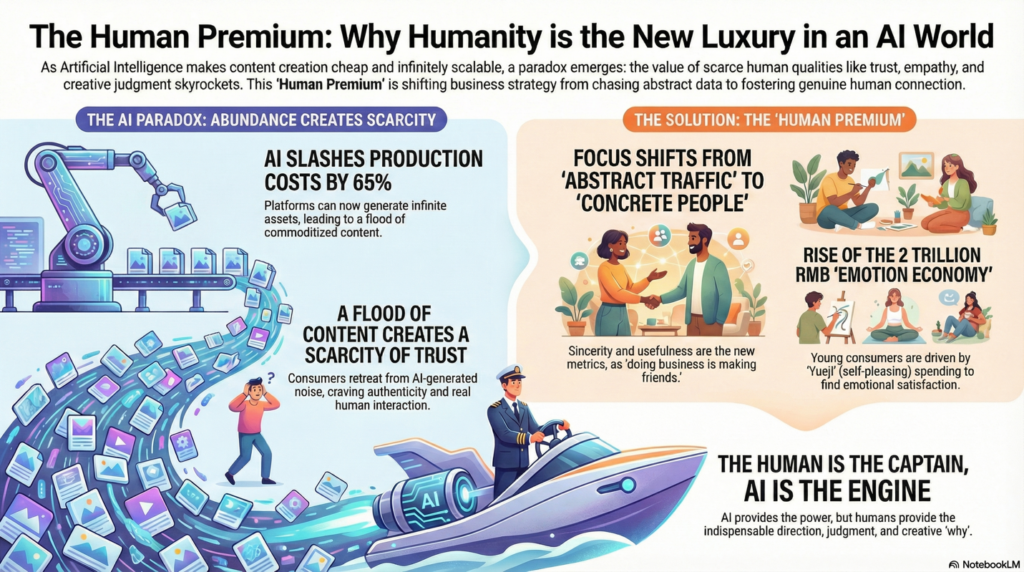
As AI commoditizes content creation and industrializes efficiency, the advertising industry is witnessing a powerful counter-trend: the skyrocketing value of authentic human connection, empathy, and “concrete” reality. While platforms like Kuaishou and Ocean Engine demonstrate how AI can reduce production costs by 65% and generate infinite assets, industry leaders argue that this very abundance creates a scarcity of trust and emotional resonance. The presentations reveal a strategic pivot from chasing abstract “traffic” to connecting with “concrete people”—a philosophy championed by Xiaohongshu (rednote), which posits that in an algorithmic world, “sincerity” and “altruism” are the only metrics that matter. This “Human Premium” is not just a sentimental preference but an economic driver, fueling China’s 2 trillion RMB “emotion economy” where young consumers spend to please themselves (“Yueji”) and find shared cultural consensus. Ultimately, while AI may serve as the engine for execution, the presentations from Dentsu, Ogilvy, and Focus Media conclude that the “human captain” remains indispensable for providing the moral judgment, creative “why,” and emotional warmth that machines cannot replicate.
From “Traffic” to “Concrete People”: The Craving for Authenticity
In a digital landscape flooded with AI-generated content, platforms are finding that users are retreating toward interactions that feel undeniably human.
- Concrete People vs. Abstract Traffic: Xiaohongshu (Rednote) argues that marketing must shift its focus from “traffic” (data points) to “concrete people.” They emphasize that in an era of algorithmic saturation, the most effective content is defined by “sincerity”—honest sharing from real users—because “good content is altruistic” and “useful to others”.
- Business as Friendship: Bilibili reinforces this by stating that for young consumers, “doing business is making friends.” Young people are tired of cold, forceful advertising; they want brands to communicate with “real feelings,” as seen when 38 million users tuned into a livestream not for a product, but for a shared moment of patriotism, proving they are not “lying flat” but deeply engaged when the emotional connection is real.
- The “To C” Caution: Focus Media warns that while AI is excellent for B2B efficiency (industrial/agricultural optimization), “To C” (consumer-facing) applications require extreme caution. Humans ultimately crave interaction with other humans for emotional support and psychological comfort. A robot can answer a query, but it cannot fully replace the warmth of a human saying, “Thank you, please sit down,” in a hospitality setting.
The “Emotion Economy”: Spending for the Soul
The “Human Premium” is driving a massive economic shift where value is derived from emotional resonance rather than just functional utility.
- The “Yueji” Consumption: iQIYI highlights the rise of the “emotion economy,” projected to be a 2 trillion RMB market in China by 2025. This is driven by “Yueji” (self-pleasing) consumption, where users spend money to please themselves and alleviate anxiety rather than to impress others. In this context, content is no longer just information; it is an emotional service.
- Empathy Points: Even when AI is used, its highest value lies in decoding human emotion. Kuaishou uses its large models not just to generate video, but to understand “empathy points”—analyzing what specifically triggers an emotional reaction in a user (e.g., the pain of “staying up late”) to help creators build stories that actually resonate.
- Consensus in Chaos: As content fragments, humans are desperate for “consensus”—shared cultural moments that make them feel part of a group. iQIYI notes that “monoculture” hits (like big dramas) act as an anchor, providing a shared emotional language that fragmented AI content cannot replicate.
Creativity: The Human “Why” vs. The AI “What”
A major sub-theme is that while AI can execute tasks, it lacks the human life experience required to understand why a creative decision matters.
- The Creative Thinking Model: Dentsu’s presentation on “AICO” (AI Copywriter) reveals that simply feeding AI data isn’t enough. They had to teach the AI the “thinking process” of a human creator. For example, when writing a headline about child abuse, a human knows to use “gentle words” because the reality is too harsh. AI must be taught this specific human sensitivity; it cannot derive “tact” or “kindness” on its own.
- High-Level Creativity is Safe: Ogilvy’s CCO noted a stark reality: “AI won’t kill high-level creativity, but it can’t save low-level creativity.” The “Human Premium” lies in the ability to tell stories, judge quality, and cross-pollinate ideas—skills that are becoming more scarce and valuable as basic execution becomes automated.
- Emotion as a Multiplier: The Cannes Lions presentation highlighted that despite the AI hype, the most effective advertising trends were “consistency” and “emotion.” AI was a tool in the background, but the “human” element of emotional coherence was the primary driver of business effects.
Techno-Humanism: AI as a Bridge, Not a Replacement
The most successful applications of AI are those that amplify human connection rather than removing it.
- Human-in-the-Loop: Kata.ai, despite selling AI automation, advises brands to “always put your best people as a human in the loop.” Customers often don’t want technology; they want the “best experience,” which often requires a human to handle complex, high-empathy situations that the AI flags.
- Techno-Humanism: RACA (Russian Association of Communication Agencies) introduced the concept of “Techno-humanism.” They noted that while AI avatars are popular, it is because they are programmed to evoke human The goal is not to replace humans, but to use technology to create new forms of human expression, warning that we must not lose sight of the person the technology is serving.
- Human-Centric Design: Studio+ advocates for “Human-Centered AI,” ensuring that systems are designed to give humans control and enhance human-to-human interaction, rather than just optimizing for machine efficiency.
In summary, Ogilvy provides a fitting analogy for this “Human Premium”: In the AI era, the agency or marketing team is like a small boat. AI is the engine, the navigation, and the rowing crew, capable of immense labor. But the Human is the Captain. The Captain provides the direction, the judgment, and the reason for the journey. Without the Captain’s human intent and ability to read the “weather” (cultural emotion), the AI ship is just a high-speed vessel with nowhere to go.