
By Iris Yim
Note: The article is based on the presentations from the China International Advertising Festival and AdAsia 2025 in Beijing on Oct. 24 – 26, 2025.
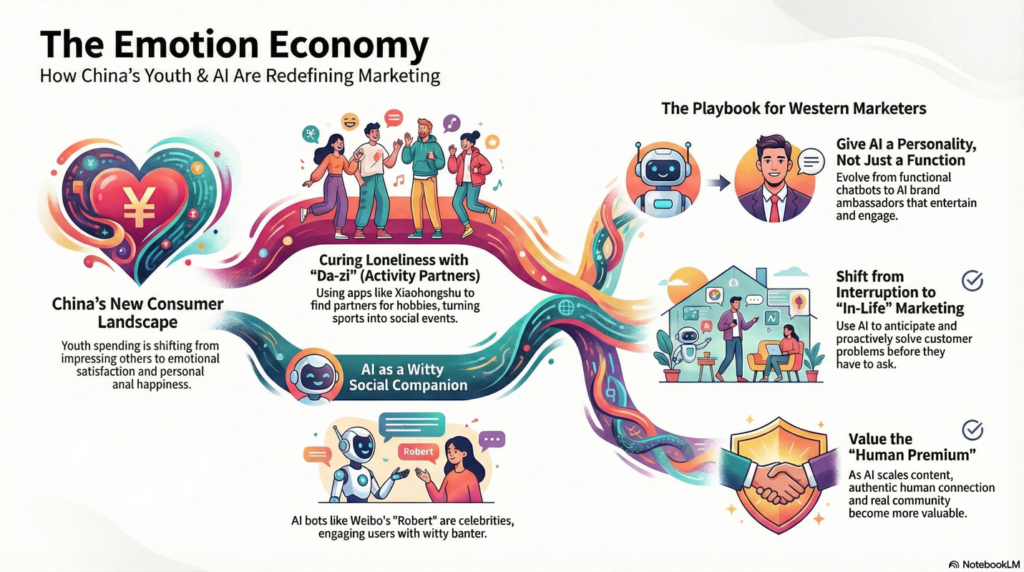
The presentations from the 2025 AdAsia and China International Advertising Festival highlight a seismic shift in the Chinese market: the rise of the “emotion economy,” a sector projected to reach 2 trillion RMB in 2025. Driven by a desire for “Yueji” (悅己) (self-pleasing) consumption, Chinese youth are moving away from status-driven purchases toward spending that offers emotional comfort, “healing,” and authentic connection. This shift is reshaping digital ecosystems, where platforms like rednote (Xiaohongshu) facilitate “Da-zi” (搭子) (finding partners for specific hobbies) to solve loneliness), while AI is embraced not just as a tool, but as a witty social companion—exemplified by Weibo’s “Robert” bot and Huawei’s emotionally intelligent in-car assistants.
The “Emotion Economy” and “Yueji” (Self-Pleasing) Consumption
A dominant theme across the presentations is the shift in spending motivation among Chinese youth. They are moving away from spending for social status toward spending for emotional satisfaction and personal happiness.
- The 2 Trillion RMB Market: iQIYI highlighted that the “emotion economy” in China is estimated to reach 2 trillion RMB (roughly double the annual revenue of Alibaba), driven by “Yueji” (self-pleasing) needs. Young people are spending money to please themselves rather than to impress others.
- Emotional Resonance over Traffic: Brands are urged to move beyond “traffic” (views) to “emotional connection.” For example, Bilibili noted that young people are willing to spend heavily on “emotional value,” citing an IP crowdfunding campaign for A Mortal’s Journey to Immortality that raised nearly 30 million RMB from fans who wanted to celebrate the protagonist’s success.
- Healing and Comfort: Kuaishou utilized AI to analyze user pain points, identifying themes like “staying up late” and “dark circles” to generate content focused on “deep slow repair” and comfort, which resonated deeply with users.
Sports Trends: The Rise of “Da-zi” and the 7 Trillion Goal
Sports and physical activity are major drivers of the new economy, but the way young people participate is socially distinct.
- “Da-zi” (Activity Partners): rednote (Xiaohongshu) highlighted a massive cultural trend called “Da-zi” (搭子). This involves finding strangers to be temporary partners for specific activities. For example, a user might post, “Who wants to play tennis this weekend?” or “Who wants to go skiing?” This transforms sports from a solitary activity into a new form of lightweight socialization.
- Sports as “First Traffic”: MIGU projected that China’s sports industry will reach 7 trillion RMB by 2030, becoming a primary source of traffic.
- Interactive Viewing: Young consumers are not just passive viewers of sports. MIGU noted they use “bullet screens” (Danmu) not just to comment, but as a venue for brand interaction, such as grabbing red envelopes during goal celebrations.
Trends in Young Consumers (Gen Z)
Bilibili and NetEase provided deep dives into the psyche of China’s youth, debunking the myth that they are “lying flat” (躺平)(lazy).
- Patriotic and Engaged: Contrary to the idea that youth are disengaged, Bilibili data showed 38 million viewers for a military parade livestream, with young people expressing deep “real feelings” of patriotism.
- Driven by Interest and Learning: Young people are highly motivated by specific interests. Bilibili noted that the fastest-growing content categories are actually educational, specifically learning how to use AI tools, as well as health and finance.
- Patience for Long Content: While short videos are popular, youth dohave patience for quality. Bilibili launched “video open courses” where single episodes last over 100 minutes, and these have been enthusiastically received, proving young people will watch long-form content if it adds value to their knowledge structure.
Interaction with AI and Advertising
Young consumers in China are interacting with AI in ways that blur the line between tool, friend, and content creator.
AI as a “Social” Entity
- The “Robert” Phenomenon: Weibo introduced “Robert,” an AI comment bot that became a celebrity. Initially “toxic-tongued” (sharp/witty), it engaged users in comment sections, leading to a massive following. Brands like auto manufacturers now use Robert to interact with fans during launches because it can generate witty, culturally relevant banter that humans can’t produce at scale.
- Emotional Companions: Petal Ads (Huawei) described AI assistants that act as friends. For example, when a user enters a car, the AI might say, “Good morning Princess, please get in the car,” or offer comfort if the user’s heart rate is high, shifting from a functional tool to an emotional companion.
Search Behavior is Changing
- From Keywords to Solutions: Users on platforms like rednote (Xiaohongshu) and Ocean Engine (Douyin) are using search differently. They don’t just search for a product name; they search for solutions (e.g., “how to find a confinement nanny” or “gift for mom”). AI helps refine these broad queries into specific purchase decisions.
- Solution-Seeking: Ocean Engine noted that 60% of e-commerce searches on Douyin now result in a transaction, as AI helps filter “noise” and provides direct answers (e.g., “where to play today”) rather than just a list of links.
User-Generated Product Development (C2B)
- Feedback Loops: Young consumers expect brands to listen. Haier shared a case where a user complained about washing underwear and socks together. This comment led Haier to develop a new “three-tub” washing machine specifically to solve this user-identified pain point. The product became a hit because it originated from direct user interaction.
Acceptance of “Digital Humans”
- 24/7 Livestreaming: Baidu highlighted that “digital human” streamers have advanced from expensive, stiff models to hyper-realistic avatars generated from a single image. These AI streamers can interact in real-time, and young consumers are increasingly accepting them as replacements for human hosts in e-commerce and entertainment.
In summary, the Chinese market is seeing a convergence of emotional needs and technological immersion. Young consumers are using AI not just to find products, but to find partners (Da-zi), solutions to life problems, and even entertainment through witty AI bots, while spending their money on things that offer personal emotional satisfaction.
Implications for US Marketers: Convergence of Emotion and Tech
The trends observed in China—where technological immersion is used to solve emotional needs—offer a roadmap for US marketers facing a similar landscape of fragmentation and consumer fatigue.
Transition AI from “Utility” to “Personality”: In the US, AI is often marketed as a productivity tool or customer support bot. In China, AI is becoming a “brand ambassador” with a distinct personality.
- Implication: US brands should develop AI agents that do more than answer FAQs; they should possess a “brand personality” capable of banter and emotional support. Weibo’s success with the “Robert” bot—which generates witty, “toxic-tongued,” or warm comments—proves that users will engage with AI if it offers entertainment value and emotional resonance.
- Action:Move beyond functional chatbots to “Character AI” that embodies the brand’s voice, engaging users in comment sections and social feeds rather than just waiting for support tickets.
Adopt “In-Life Marketing”: Predict Needs Before the Ask: Chinese ecosystems are moving from “interruptive” advertising to “in-life” marketing, where AI anticipates needs based on physiological and environmental data.
- Implication: US marketers must leverage data to become “invisible intelligence”. Instead of blasting ads, AI should trigger helpful interventions. For example, Haier’s ecosystem adjusts appliances based on user body temperature or suggests laundry solutions based on weather.
- Action: Shift focus from “Interruption” (buying attention) to “Utility” (solving problems proactively). Marketers should build “Agentic AI” workflows that can autonomously identify a customer’s specific life moment (e.g., searching for a “weekend partner”) and offer a solution, not just a product banner.
Frictionless “Agentic” Commerce: The Asian market is pioneering “Agentic Commerce,” where the transaction is handled entirely by an AI agent within a chat or social feed, eliminating the need to visit a website.
- Implication: The US funnel is still friction-heavy (Ad -> Click -> Landing Page -> Cart). The future is “eliminating the transaction entirely from the customer’s conscious experience”.
- Action Brands should integrate payment and selection capabilities directly into conversational AI interfaces (like WhatsApp or Messenger agents), allowing the “Emotion Economy” impulse to convert into a sale instantly without breaking the immersion.
The “Concrete Human” Premium: As AI content scales, the value of human authenticity (the “human premium”) increases.
- Implication: While AI can generate infinite content, trust is built on “concrete people” and shared real-life experiences. Xiaohongshu’s success lies in connecting real people for offline activities (Da-zi) rather than just generating traffic.
- Action: Use AI to handle the “Back-end” (B2B efficiency, data sorting, asset generation) but ensure the “Front-end” (C-facing interaction) retains a strong human or community-verified element. As Focus Media noted, “To C” (consumer-facing) AI applications require caution to avoid alienation; the human connection remains the core of advertising.
Building “Consensus” in a Fragmented World: In a world of infinite niche content, brands struggle to create mass awareness.
- Implication: To tap into the “emotion economy,” brands must create “consensus” moments—large-scale cultural events that unify fragmented audiences. iQIYI noted that despite fragmentation, audiences still crave “monoculture” hits (like big dramas or sports events) to feel a sense of belonging.
- Action: Invest in high-quality, long-form content or major IP collaborations that generate “emotional resonance” and shared cultural currency, rather than relying solely on micro-targeted, short-term performance ads.