
By Iris Yim
Note: The article is based on the presentations from the China International Advertising Festival and AdAsia 2025 in Beijing on Oct. 24 – 26, 2025.
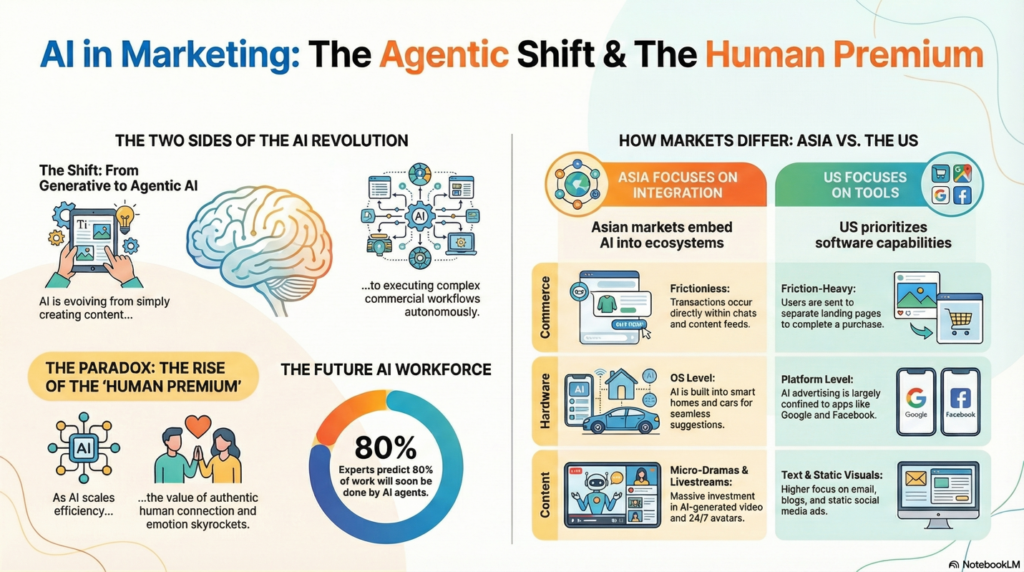
The presentations from the 2025 AdAsia and China International Advertising Festival reveal an industry at a critical inflection point: a rapid evolution from Generative AI (creating content) to Agentic AI—autonomous systems capable of reasoning, planning, and executing complex commercial workflows with minimal human oversight. While the US and global markets focus on tool capabilities, Asian markets are pioneering the integration of these agents into “super ecosystems,” where AI is embedded directly into the operating systems of homes, cars, and social platforms to eliminate transactional friction entirely. However, a powerful paradox has emerged: as AI scales industrial efficiency, the value of “concrete” human connection and emotional resonance is skyrocketing. From the “emotion economy” driving Chinese youth consumption to the “seeding” strategies of platforms like Xiaohongshu (rednote), the data suggests that in a world saturated with AI-generated content, the ultimate luxury for brands is no longer just traffic, but the ability to provide emotional value, companionship, and authentic human-centric solutions.
The Shift to “Agentic” and Human-Centricity
From Generation to Action (Agentic AI): A dominant theme is the evolution from AI that merely writes or draws to “Agentic AI”—systems capable of autonomy, reasoning, and executing complex workflows.
- Defining the Shift: Accenture defines Agentic AI as “goal-oriented” and “action-oriented,” capable of making decisions with minimal human oversight, unlike traditional AI which is rule-based, or GenAI which is creation-oriented.
- The AI Workforce: 4sightAI predicts that soon, “80% of your work is done by AI, 20% is done by humans,” urging agencies to build their own Large Language Models (LLMs) to replicate specific workforce processes,.
- Conversation to Conversion: Kata.ai and The Fabric highlighted that AI is moving beyond customer support to becoming the “face of the brand,” handling transactions and closing sales via chat without human intervention,.
- The “Human” Premium: Paradoxically, as AI scales, the value of human connection and “realness” is skyrocketing.
- Emotional Connection: Dentsu introduced a “Creative Thinking Model” to teach AI not just what to write, but the human reasoning and emotion behind specific copy choices,.
- Real People vs. Traffic: Xiaohongshu (Rednote) emphasized connecting with “concrete people” rather than abstract traffic figures, focusing on “seeding” (Caozhong) content that addresses real-life emotional needs and trends (e.g., finding “partners” for hobbies).
- Cultural Resonance: Phoenix New Media and iQIYI argued that in a fragmented, AI-saturated world, brands must provide emotional value and consensus, as consumers are willing to spend on “emotional consumption”.
AI as Infrastructure (The “AI-First” Model): AI is no longer a tool; it is the operating system.
- Ecosystem Integration: Companies like Huawei (Petal Ads) and Haier are embedding AI into the hardware and OS level (e.g., cars, appliances), creating a “neural network” of touchpoints that goes far beyond traditional ad slots,.
- Marketing Science: Ocean Engine (Douyin/TikTok) and Tencent are using AI to automate the entire marketing loop—from insight generation to asset creation, issuance, and valuation—treating marketing as a scientific, data-driven workflow.
Trends in Asia vs. The US: How They Differ
While the US focuses heavily on the tools (LLM capability, software features), Asia is focusing on integration and content formats.
| Feature | Asia (China/SE Asia) Focus | US Focus (Contrast) |
| Commerce Integration | Seamless / Frictionless: Transactions happen inside the chat or content feed (e.g., buying via a WhatsApp agent or Douyin video). “The future of commerce is… eliminating the transaction entirely”. | Friction-Heavy: AI often directs users to a landing page or website to complete a purchase; the ad and the shop remain distinct steps. |
| Content Formats | Micro-Dramas & Livestreaming: Massive investment in AI-generated “short dramas” (micro-soaps) and AI avatars for 24/7 livestream commerce,. | Text & Static Visuals: Higher focus on email marketing, blog content, and static social ads; AI video is emerging but less commercialized at scale. |
| Hardware Ecosystems | IoT & OS Level: Brands like Haier and Huawei integrate ads into the “smart home” and “smart car” experience (e.g., AI sensing user body temp to adjust AC and suggest products),. | Platform Level: Advertising is largely confined to apps (Facebook, Google) rather than the operating system of the device itself. |
| Speed & Volume | “China Speed”: High volume of assets. Brands produce thousands of assets; Ocean Engine noted a 65% reduction in production costs using AI for video. | Precision & Safety: Slower adoption due to copyright/legal fears; focus on “copilots” aiding humans rather than fully autonomous production loops. |
Implications for US Marketers
- Prepare for “Machine-to-Machine” Marketing: You may soon be marketing to an AI, not a human. 4sightAI predicted that in the future, “majority of the advertisements you will build for other AI agents.” A consumer’s personal AI will talk to a brand’s AI to filter products.
Implication: US marketers must structure data and product information so it is optimized for machineingestion, not just human readability. - Shift to “Seeding” (Caozhong) Strategies: The Chinese concept of “Seeding” (popularized by Xiaohongshu) involves planting product ideas deeply into lifestyle content and community discussions rather than just blasting ads.
Implication: US brands should move beyond “interruption” advertising toward “in-life marketing,” where AI helps identify niche cultural moments (e.g., a specific “weekend hobby partner” trend) to insert products organically. - Adopt Avatar and Digital Human Workforces: The use of AI avatars is becoming normalized in Asia and Russia for continuous engagement. RACA noted that avatars can have engagement rates four times higher than real influencers and eliminate reputational risk,. Baidu has moved to “digital humans” that can be generated from a single image and livestream 24/7.
Implication: US brands should explore digital ambassadors for always-on social commerce to reduce talent costs and extend operating hours. - Build “Context” into AI Models: Simply using ChatGPT is insufficient. 4sightAI emphasizes building a proprietary LLM trained on three specific contexts: Historical (past campaign data), Subject Matter (how your best experts work), and Engagement (client nuances).
Implication: US agencies must capture the “thinking process” of their best creatives (as Dentsu is doing) to train private models, rather than relying on generic public models. - The “Billion Dollar Hole” of Wasted Ad Spend: Asian and global speakers alike highlighted that despite tech, ~50% of ad spend is still wasted. The solution proposed is Attribution AI—using AI not just to make ads, but to track the “lost numbers” and close the loop between a view and a sale, particularly in offline scenarios.
Implication: Focus AI investment on measurement and conversion(Agentic AI) rather than just creative generation.
In summary, the presentations suggest that while the US drives the invention of core AI models, Asia is leading the application of AI into commercial ecosystems, blurring the lines between content, device, and transaction. US marketers must prepare for a future where marketing is autonomous, hyper-integrated, and mediated by AI agents.